
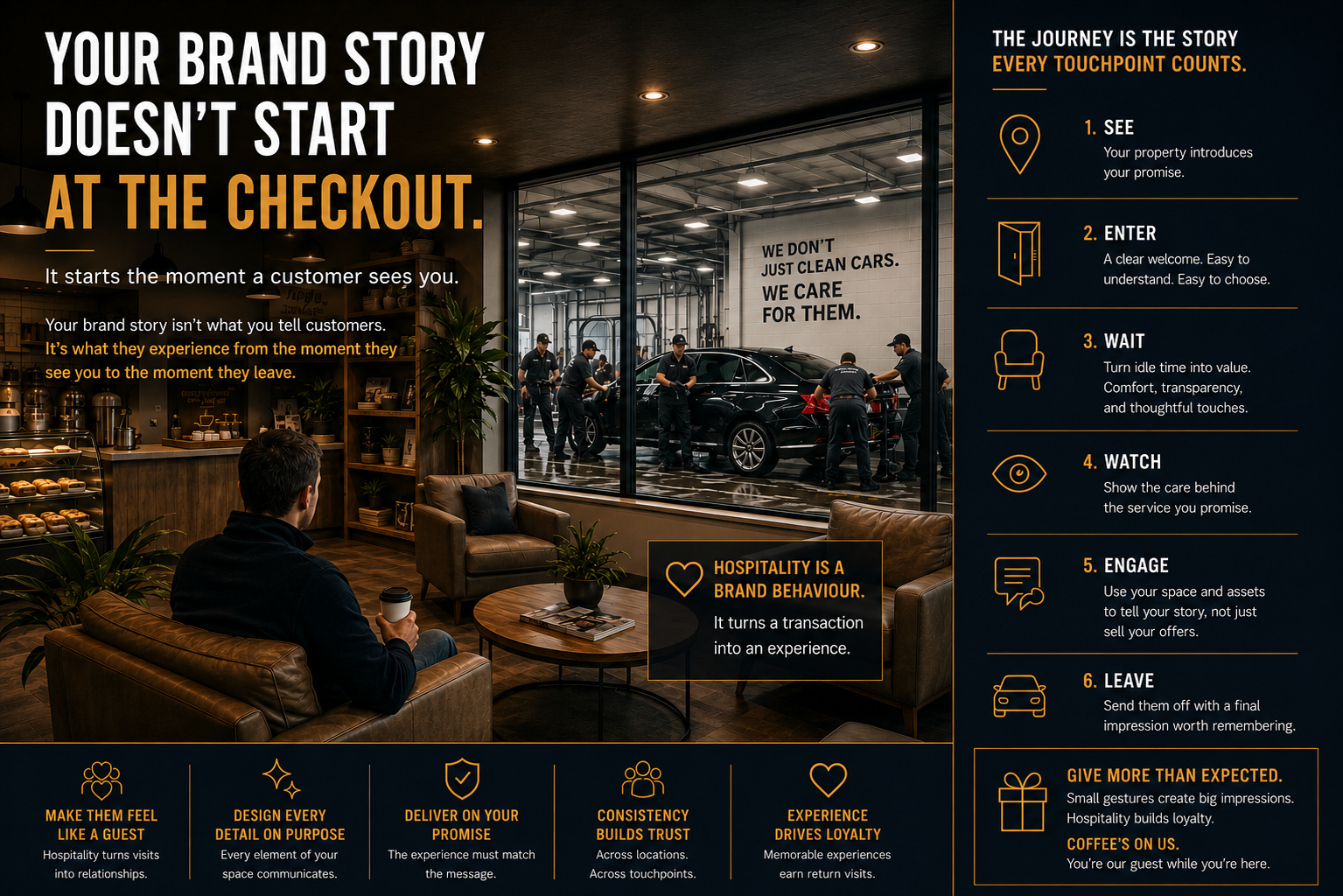
It Starts the Moment a Customer Sees You.
We often talk about brand storytelling as though it happens in advertisements. A video tells the story. A website tells the story. A campaign tells the story. What if the most powerful version of your brand story isn’t something you tell at all? What if it is something your customers experience?
From the moment they see your business to the moment they leave, customers are constantly receiving information. The building. The entrance. The smell. The people. The music. The lighting. The language. The waiting area. The products on the counter. The extra delights. The way an employee says hello. None of these things may appear in your brand guidelines (and maybe they should). Yet together, they tell a story.
Your brand story isn’t what you tell customers. It’s what they experience from the moment they see you to the moment they leave.
The Customer Journey Is the Story
Customer experience research has increasingly moved beyond individual transactions to examine the entire customer journey. Lemon and Verhoef describe customer experience as something that develops across multiple touchpoints over time; customers interact with businesses through many different points of contact, and those experiences need to work together rather than exist as isolated moments. [1]
That sounds obvious, yet walk through almost any business as a customer and you’ll find the opposite. The advertisement promises one thing and the building communicates another. The employee behaves differently. The waiting experience says something else entirely. The customer may never consciously identify the contradiction, yet they experience it.
A brand isn’t experienced in pieces. It is experienced as a whole.
A Space Can Speak
Consider a business with a waiting area. The obvious purpose is to give customers somewhere to sit yet, the space can do considerably more.
Is it bright or dark? Comfortable or functional? Quiet or energetic? Can customers see what is happening behind the scenes? Are they surrounded by clutter or intentional design? Are there things to discover? Does the space feel like somewhere the business expects customers to spend time, or somewhere they are simply being stored until their transaction is finished?
Mary Jo Bitner’s research into servicescapes established a framework for understanding how physical surroundings influence customers and employees. The environment is not simply a backdrop to a service; it can play strategic roles in shaping behaviour and perceptions. [2]
That changes the way we should think about a waiting room. t isn’t dead space. It is part of the brand.
Consider the Car Wash
A car wash makes this particularly easy to see. Imagine arriving for a detail and walking into a bright, open waiting area. There are comfortable chairs. You can see your vehicle moving through the process. A team of employees is working around it.
There is movement. There is activity. There is transparency. Perhaps there is a small café-style counter where you can get a coffee or something to eat.
You aren’t simply waiting for your car. You’re experiencing the business. The waiting period has become part of the product and that matters because the customer is no longer wondering what is happening. They can see it. They can see the work. They can see the people. They can see the care.
The physical environment is helping prove the brand promise.
Hospitality Is a Brand Behaviour
This is where I think hospitality becomes particularly interesting. Hospitality is often associated with hotels and restaurants. But it doesn’t belong exclusively to hospitality businesses.
A car wash can be hospitable. A dealership can be hospitable.A contractor can be hospitable. A financial advisor can be hospitable. A retail store can be hospitable.
Hospitality simply asks a different question: How does the customer feel while they are here?
That question can change the design of an experience. Instead of asking: “Where can we put the waiting chairs?” You might ask: “How would we want someone to feel while they wait?” Instead of: “What can we sell them while they’re here?” You might ask: “What could we do that makes being here a little better?”
That is a very different starting point.
Give More Than Expected
This is where a small gesture can become disproportionately meaningful. Imagine you’re waiting for your vehicle. The business offers you a coffee. Not a vending machine. Not a $3.50 cup of coffee pushed across the counter. Just: “Coffee’s on us.”
It is a small thing. But the coffee isn’t really the point. Hospitality is. The gesture says: You’re our guest while you’re here.
Perhaps there are also baked goods or snacks available for purchase. The business may sell one. It may sell ten. It may sell none. That’s almost beside the point. The coffee should be worthwhile even if the customer never buys anything else. If someone does decide to purchase a snack, that’s a welcome commercial outcome but, shouldn’t be the reason for the generosity.
Research on service gifts has found that unexpected benefits can influence reciprocal behaviour, although the effect depends on how customers interpret the relationship and the motive behind the gesture. [3]
More recent research into unconditional gifts similarly suggests that gifts can affect customer-firm relationships, while also showing why the perceived motive behind the gift matters. [4]
That distinction matters.
Hospitality shouldn’t feel like a sales tactic disguised as generosity.
It should feel generous. Experience Is More Than What We See.
Brand experience research gives us another useful lens. Brakus, Schmitt, and Zarantonello describe brand experience through sensory, affective, intellectual, and behavioural dimensions. Their research found that brand experience can influence satisfaction and loyalty. [5]
That means a brand isn’t experienced only through its logo or advertising. It can be experienced through the way a space sounds. The way it smells. The way it looks. The way it feels. The way people interact. The things customers are invited to do. The things they are allowed to discover.
The experience becomes an expression of the brand.
Every Touchpoint Should Tell the Same Story
Imagine a company positioning itself as premium. Its advertising is beautiful. Its logo is refined. Its website is sophisticated. Then the customer arrives. The parking lot is poorly maintained. The entrance is cluttered. The waiting room is uncomfortable. The promotional material is printed on cheap paper. An employee barely acknowledges them. Which story does the customer believe? The advertising? Or the experience?
The answer is obvious. The experience wins. This is why brand consistency is more than using the same logo and colours across multiple locations. It means creating consistency in what the customer feels.
A business can have different locations, different buildings, different layouts, and different communities yet, the underlying experience should still feel unmistakably connected.
Marketing Should Reinforce the Experience
This doesn’t mean removing marketing from the environment, in fact, it’s quite the opposite. It means making marketing work harder.
A display in the waiting area can explain the brand’s history. A screen can show how the service works. Photography can introduce the people behind the business. Packaging can reinforce the brand’s personality. A membership display can communicate value without overwhelming the customer. A simple message can explain why the company does what it does. The difference is that these assets aren’t interrupting the experience. They are contributing to it.
Marketing becomes part of the story rather than a series of sales messages competing for attention.
What This Study Taught Me
Storytelling is often treated as something a brand communicates. We think it is more useful to think of it as something a brand constructs.
The customer sees the building. They enter. They interact. They wait. They observe. They receive. They leave.
Every moment adds another sentence. Every touchpoint adds another detail. Every interaction either reinforces the story or contradicts it.
Sometimes the most memorable part of the experience isn’t the thing you spent the most money designing. It is the comfortable chair. The employee who remembered your name. The ability to see the work being done. The unexpected coffee. The small gesture that made you feel like a guest rather than a transaction. That’s hospitality, and perhaps that’s one of the most powerful forms of branding there is.
The best brands don’t simply tell customers what they stand for. They give customers a reason to feel it.
Selected Research & Reading
[1] Lemon, K. N., & Verhoef, P. C. (2016). Understanding Customer Experience Throughout the Customer Journey. Journal of Marketing, 80(6), 69–96.
[2] Bitner, M. J. (1992). Servicescapes: The Impact of Physical Surroundings on Customers and Employees. Journal of Marketing, 56(2), 57–71.
[3]Service gifts, collective social connection and reciprocity. European Journal of Marketing, 54(10), 2477–2500 (2020).
[4] Fombelle, P. W., Voorhees, C. M., Gustafsson, A., Witell, L., et al. (2026). The effects of unconditional gifts on customer-firm relationships. Journal of the Academy of Marketing Science, 54, 557–578.
[5] Brakus, J. J., Schmitt, B. H., & Zarantonello, L. (2009). Brand Experience: What Is It? How Is It Measured? Does It Affect Loyalty? Journal of Marketing, 73(3), 52–68.