
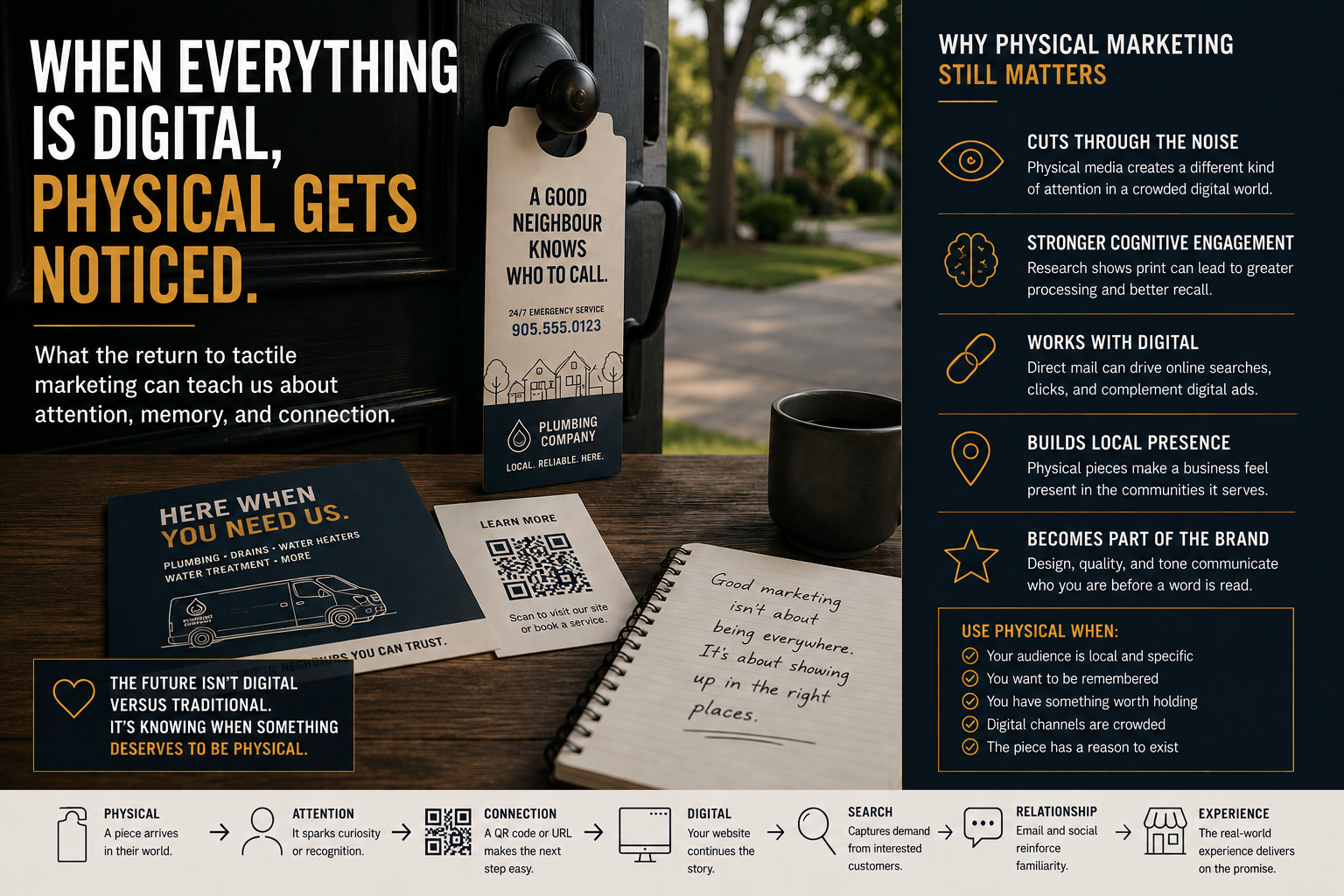
What the return to tactile marketing can teach us about attention, memory, and connection
What Happens When Marketing Becomes Physical Again?
A conversation this week raised an interesting question: what happens when marketing becomes physical again?
The conversation centred on local traditional advertising; printed door knockers, hand-delivered materials and other forms of advertising that physically arrive in someone's space. In an environment where so much marketing has moved to screens, feeds, inboxes and search results, there was something compelling about the idea of putting a message directly into someone's hands.
It would be easy to interpret this as evidence that traditional advertising is making a comeback, yet the research suggests something more nuanced.
Physical marketing isn't necessarily better than digital marketing. Rather, physical media can create a different kind of interaction with a message, and that difference may be particularly valuable in an increasingly digital environment.
That raises a more interesting question for marketers; When does a message deserve to be physical?
We've Become Very Good at Making Marketing Disappear
Digital marketing has given businesses capabilities that traditional media could never match. Audiences can be targeted with extraordinary precision, creative can be changed almost instantly, and nearly every interaction can be measured.
But there is a paradox in all of this efficiency.
The more digital marketing becomes optimized, the more crowded the digital environment becomes. Email competes with email. Social content competes with social content. Search ads compete with search ads. Notifications compete with notifications.
The result isn't that digital marketing has stopped working. It hasn't. The problem is that attention has become increasingly difficult to earn. Consumers are constantly being asked to stop, look, click, swipe, watch and respond. A good advertisement can appear on someone's screen and disappear again within seconds.
Physical media operates differently.
A printed piece can sit on a kitchen counter. A door knocker can remain on a front door. A brochure can be placed in a vehicle. A well-designed piece can be picked up, handled, turned over and looked at again. It occupies physical space.
It’s this that gives marketers another dimension to work with; not just attention, but presence.
Physical Changes the Relationship With the Message
There is something fundamentally different about receiving something physical.
We don't simply see it. We interact with it.
The size, weight, texture, material and quality of the object can all contribute to how the message is experienced. Even the decision to keep something, throw it away or put it somewhere for later becomes part of the interaction.
Research into consumer touch supports the broader idea that physical interaction can influence how consumers experience information, products and brands. Recent research continues to examine the role of haptic information and sensory engagement in consumer psychology, suggesting that touch is not merely a functional sense but an important part of how people process and evaluate experiences.
That doesn't mean every printed advertisement will be remembered. It means the physical nature of the medium gives the marketer additional tools that don't exist in the same way on a screen.
And sometimes those tools may be exactly what a message needs.
A Door Knocker Is Not Just a Flyer
Consider a local plumbing company.
The conventional digital approach might be a social advertisement or Google campaign telling homeowners to call when they need a plumber. There is nothing inherently wrong with that approach. Now imagine a well-designed door knocker arriving at the front door.
It might say: A Good Neighbour Knows Who to Call.
The company's name and promise are immediately visible. The piece provides a useful emergency number and perhaps a QR code that leads directly to the company's website. The physical and digital channels are now doing different jobs.
The door knocker creates the interruption and establishes presence. The QR code provides a convenient transition to digital. The website provides more information. Search captures people who aren't ready to act immediately. Email can continue the relationship.
The physical piece isn't replacing digital marketing; it's creating a reason to enter it.
Research supports this idea of channels working together rather than simply competing with one another. A field experiment published in the International Journal of Research in Marketing found that direct mail could influence online search and clicking behaviour, while also finding positive synergy between direct mail and display advertising.
Similarly, research published in the Journal of the Academy of Marketing Science found that direct mail and email can play different roles in the customer journey. Direct mail was particularly effective for customer acquisition, while email performed better among existing customers.
The implication is important. The question isn't which medium wins. The question is what job each medium should do.
Traditional Doesn't Automatically Mean Effective
This is where the conversation needs some restraint.
There is an understandable temptation to romanticize traditional advertising. Physical mail feels tangible. Hand delivery feels personal. Print can feel more permanent.
But nostalgia isn't a marketing strategy.
A poorly designed flyer is still a poorly designed advertisement. A door knocker with no compelling message can still end up in the recycling bin. Printing something doesn't make it memorable simply because it exists in physical form. Traditional doesn't automatically mean effective and recent research reinforces that point.
A 2025 study published in the Journal of Advertising Research examined direct mail across four studies and found that it was more effective than email for non-profit donation requests, but it did not provide a general advantage for for-profit organizations when the objective was driving purchases. The researchers also found that perceptions around resource use and sustainability influenced consumer responses.
That's a much more useful conclusion than simply declaring that print is back.
The evidence suggests that context matters. Audience matters. Objective matters. Execution matters. Perhaps, most importantly, the relationship between channels matters.
So When Is Physical Worth Being Physical?
Rather than asking whether a business should "go back" to traditional advertising, we can ask a better strategic question: When does a message benefit from becoming physical?
There are several situations worth considering.
First, when the audience is geographically concentrated. A local business may not need to reach hundreds of thousands of people. It may need to reach a few thousand households within a specific area.
Second, when the message benefits from repetition or visibility. A physical piece can remain in someone's environment long after the initial interaction.
Third, when the brand has something worth experiencing. Paper stock, texture, shape, photography, illustration, packaging and craftsmanship can all become expressions of the brand.
Fourth, when digital channels are particularly crowded. Sometimes differentiation comes not from creating another digital advertisement, but from doing something that doesn't look like everything else competing for attention.
And fifth, when the physical piece has a legitimate reason to exist. It should be useful, interesting, relevant, beautiful, unexpected or memorable. Ideally, it should accomplish something that a digital message cannot accomplish as effectively.
That last point may be the most important.
The goal shouldn't be to make marketing physical. The goal should be to make the marketing more effective.
The Physical and Digital Worlds Don't Have to Compete
Perhaps the biggest mistake is treating physical and digital marketing as opposing camps. They aren't.
A strong campaign might look something like this:
Physical: A beautifully designed piece arrives at the door.
Attention: The piece creates curiosity or recognition.
Connection: A QR code or memorable URL makes the next step easy.
Digital: The website continues the story.
Search: Search captures existing demand.
Social: Social reinforces familiarity and recognition.
Email: Email develops the relationship.
Experience: The customer encounters the brand in the real world.
Each channel has a role. The strategy comes from understanding how those roles fit together.
This is particularly important from a branding perspective. A physical advertisement isn't simply another media placement. It is another opportunity for the brand to show up.
Physical Marketing Can Create Presence
For local businesses, this may be one of the most interesting advantages.
A company can have an excellent website, an active social presence and strong search visibility without ever really feeling local.
Digital channels can tell someone where a business is located. Physical marketing can make the business feel present in the community.
A branded piece arriving at a home communicates something subtly different:
They're here.
They serve this neighbourhood.
I've seen this company before.
I recognize that name.
Recognition is an important part of building brands. Repeated exposure, distinctive assets and consistent presentation all contribute to the development of memory structures around a brand.
Physical marketing can therefore do more than generate an immediate response. It can contribute to familiarity, and it’s familiarity that matters the most when the customer eventually needs the product or service.
The Physical Object Can Become Part of the Brand
This is where the conversation moves beyond marketing channels and into branding. A door knocker isn't simply a format for delivering information. It can become part of the brand experience.
The typography, colour, photography, language, shape, paper stock and even the way the piece is delivered can communicate something about the business.
A premium brand shouldn't necessarily communicate premium through a beautifully designed website and then arrive at someone's home as a flimsy piece of paper covered in competing offers.
The experience should make sense. The medium should feel like the brand. This is the same principle that applies to every other touchpoint. A sign. A website. A sales conversation. A package. An email. A storefront. A waiting room. A vehicle. A door knocker.
None of these exists in isolation. Together, they tell the customer what the brand is.
Perhaps the Future Isn't Less Digital
Digital marketing isn't going anywhere; nor should it.
The opportunity isn't to return to a world before social media, search advertising and email. It's to become more thoughtful about what each medium can actually accomplish.
When every business has access to essentially the same digital platforms, the opportunity may increasingly come from understanding how to use those platforms alongside the physical world.
Sometimes the best way to stand out online is to do something offline. Sometimes the best way to make a physical campaign effective is to connect it to digital. And sometimes the smartest marketing decision isn't choosing the newest channel; it's choosing the channel that gives the message the best chance of being noticed, understood and remembered.
What This Study Taught Us
We started with a simple question: Is traditional marketing coming back?
The research doesn't give us a simple yes. And that's probably a good thing.
What it does suggest is that physical media still has a meaningful role in the marketing mix. Print can create different forms of engagement, direct mail can influence online behaviour, and physical and digital channels can work together rather than simply compete. At the same time, physical media isn't universally more effective; its value depends on the audience, objective, execution and context.
So perhaps the lesson isn't: Go back to traditional marketing. Perhaps it’s: Stop treating marketing channels as competing boxes.
A screen has advantages. A piece of paper has advantages. A conversation has advantages. A sign has advantages. A package has advantages.
The job of strategy is to understand which one matters, when it matters, and why because when everything is digital, perhaps the most disruptive thing a brand can do...is leave the screen.
Selected Research & Reading
[1] Togawa, T., Ishii, H., Onzo, N., Kwon, S., & Hiraki, I. (2024). Effects of Offline Versus Online Promotional Media on Consumer Response: Can Print versus Online Coupons Be More Effective at Increasing Redemption Behavior? Journal of Advertising Research, 64(4).
[2] Valenti, A., Srinivasan, S., Yildirim, G., & Pauwels, K. (2024). Direct mail to prospects and email to current customers? Modeling and field-testing multichannel marketing. Journal of the Academy of Marketing Science, 52, 815–834.
[3] Lesscher, L., Lobschat, L., & Verhoef, P. (2021). Do offline and online go hand in hand? Cross-channel and synergy effects of direct mailing and display advertising. International Journal of Research in Marketing, 38(3), 678–697.
[4] Hong, J. S., & Ringor, C. M. (2025). Revisiting Direct Mail Effectiveness: Balancing Organizational Goals with Consumer Sustainability Concerns. Journal of Advertising Research.