
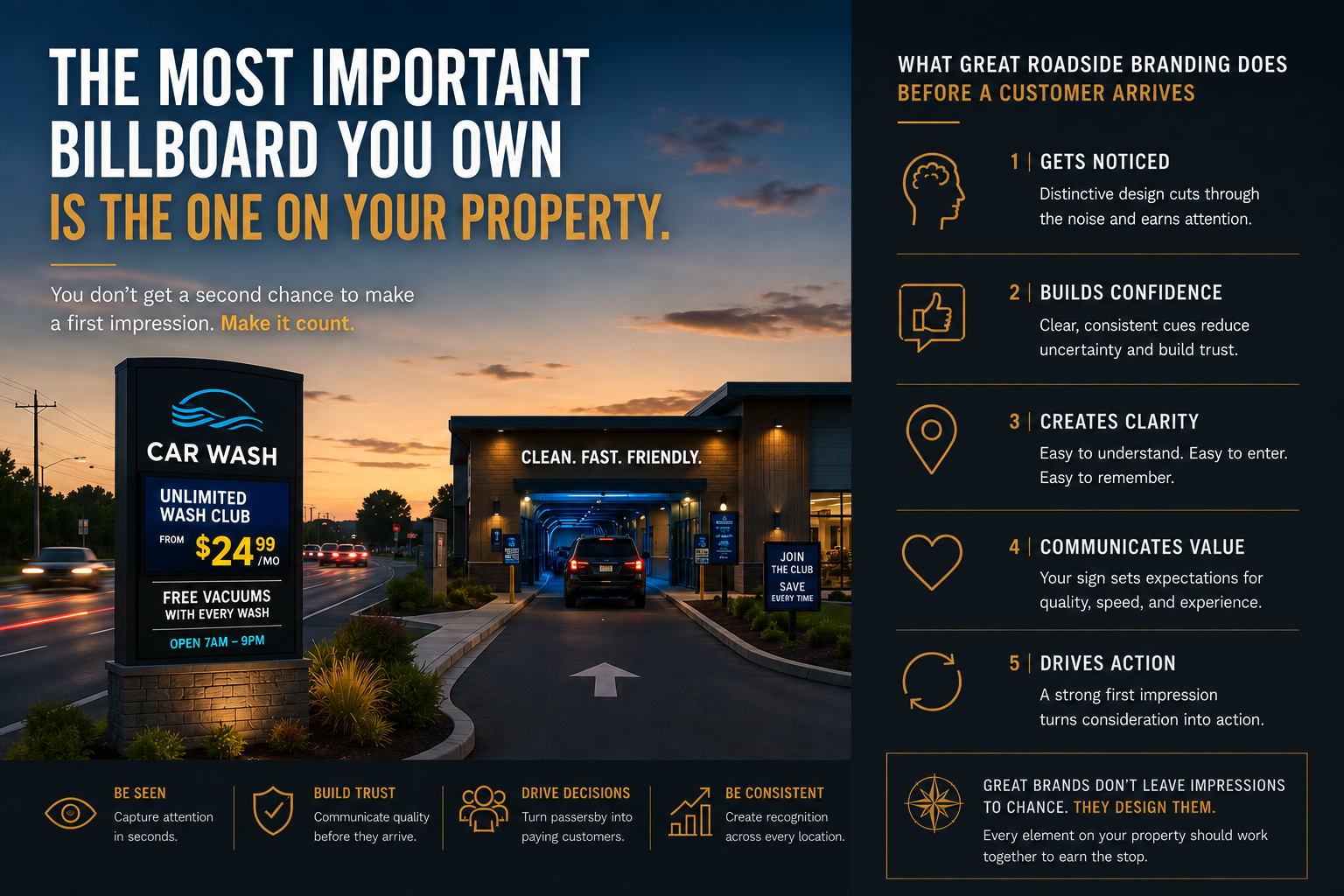
Why the Drive By Matters More Than You Think
Most businesses don't own a billboard and yet, every business owns something even more important; the view from the street.
Every day, thousands of people drive past businesses they never notice, never remember, and never consider. Not because those businesses are poor. Because they fail to communicate anything worth remembering.
For car washes, this matters even more.
Unlike many retailers, a car wash often relies on impulse decisions. A driver may not have planned to stop until they passed the property. That means the customer's first impression isn't created by a website or an advertisement. It's created through the windshield.
That raises an interesting question; what is your property actually saying?
Your Sign Isn't Giving Directions. It's Making Promises.
Most business owners view roadside signage as navigation. Its job is to tell people where they are. However, customers see something different; they see clues.
A professionally designed sign suggests professionalism inside. A faded sign raises questions before a customer has even entered the property.
Clean landscaping suggests attention to detail. An organized queue suggests efficiency. Lighting suggests safety. Even before someone becomes a customer, they're already making assumptions about the experience ahead.
Your roadside presence is not simply identifying your business. It is introducing your brand.
Recognition Happens Faster Than Reading
Drivers rarely study signs yet they do recognize them. Marketing researcher Jenni Romaniuk argues that strong brands build what she calls distinctive brand assets. These are visual elements that make a business immediately recognizable without requiring careful thought.[1]
For example; colour, typography, shape, lighting, and architecture. These elements work together to create recognition long before someone reads a single word.
This matters because people driving past your business have very little time to process information. The businesses that win are often the easiest to recognize. Not the ones that say the most.
Simplicity Is a Competitive Advantage
Many roadside signs try to communicate everything; prices, packages, memberships, promotions, phone numbers, websites, social media, and the list goes on with the result often being visual noise.
Research on processing fluency suggests people naturally prefer information that is simple and easy to understand. Information that requires less mental effort tends to feel more familiar, more trustworthy, and easier to remember.[2]
If good signage reduces thinking then great signage reduces uncertainty.
If someone needs several seconds to understand your sign, you've already asked too much of them.
Consistency Builds Confidence
One location can build recognition. Multiple locations build memory but only if they look related.
Some of the world's strongest brands rarely redesign each location independently. Whether you drive past a McDonald's, Starbucks, Costco, or Tim Horton’s, you immediately recognize the business before you consciously process its name.
The buildings feel familiar. The colours are familiar. The signage feels familiar.
That consistency reduces uncertainty. Customers know what to expect before they even turn into the parking lot.
Brand consistency isn't about making every location identical. It's about making every location unmistakably connected.
Standing Out Without Breaking the Rules
Municipal sign bylaws often become the convenient explanation for mediocre roadside branding. "Our sign can only be so big. Our municipality doesn't allow illuminated pylons. Everyone has the same restrictions."
Exactly. That's what makes branding interesting.
If everyone is working within similar constraints, why do certain businesses still dominate attention?
Because visibility isn't determined by size alone. Distinctive colour, thoughtful lighting, clean architecture, purposeful landscaping, building materials, canopies, flags, directional signage, vehicle flow, even the uniforms worn by employees all contribute to what people notice from the road.
The businesses that stand out rarely do so because they have bigger signs. They stand out because every visible element works together.
The Sign Is Only the Beginning
The roadside sign is often treated as the first impression but in reality, it's only the beginning of one.
As drivers approach the property, they continue gathering information; is the entrance obvious? Does traffic flow smoothly? Is the tunnel visible? Does the property feel maintained? Is it busy? Would it be easy to enter? Every one of these observations shapes expectations before a customer has spent a single dollar.
Branding doesn't begin at the pay station.
It begins at the curb.
Selected Research & Reading
[1] Romaniuk, J. (2018). Building Distinctive Brand Assets. Oxford University Press.
[2] Alter, A. L., & Oppenheimer, D. M. (2009). Uniting the Tribes of Fluency to Form a Metacognitive Nation. Personality and Social Psychology Review.
[3] Keller, K. L. (1993). Conceptualizing, Measuring, and Managing Customer-Based Brand Equity. Journal of Marketing.
[4] Sharp, B. (2010). How Brands Grow. Oxford University Press.