
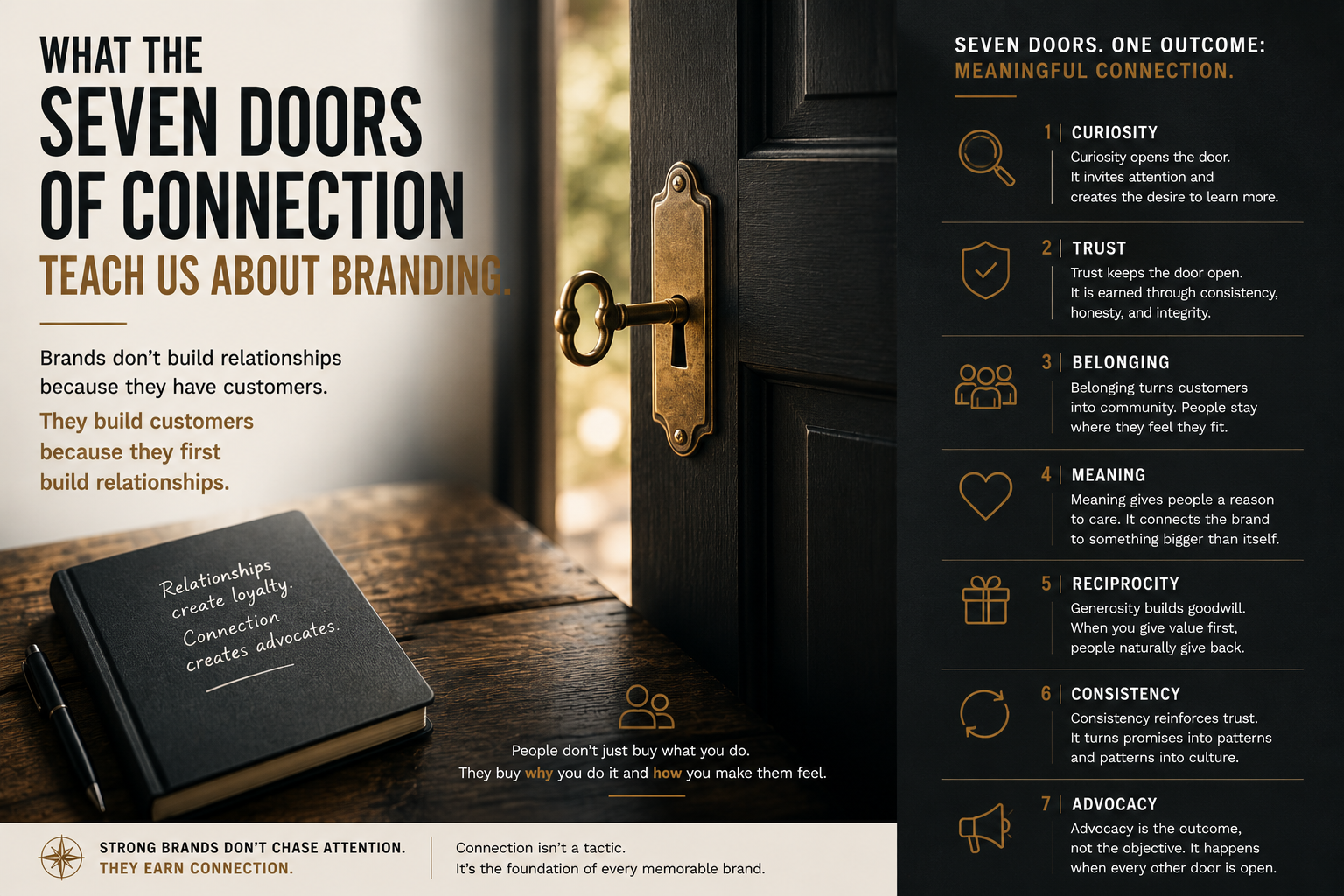
Why Meaningful Brands Build Relationships Before They Build Customers
Businesses spend enormous sums trying to capture attention. Far fewer spend time understanding connection. Yet if branding is ultimately about relationships, perhaps connection deserves more study than attention ever has.
While reading Jean-Claude Saade's The Seven Doors of Connection, we began wondering whether the framework extended beyond personal relationships; could these same principles help explain why certain brands become meaningful to people?
Saade's work explores seven "doors" that strengthen human relationships. Although the framework was not developed specifically for branding, many of its principles closely align with established research in marketing, psychology, and organizational behaviour.
Perhaps that should not surprise us.
Brands do not build relationships because they have customers. They build customers because they first build relationships.
The First Door: Curiosity
Every relationship begins somewhere. Often, it begins with curiosity. Businesses frequently mistake attention for curiosity. Attention is something you purchase. Curiosity is something you earn.
Psychologist George Loewenstein's Information Gap Theory suggests that curiosity emerges when people recognize a gap between what they know and what they want to know. That gap motivates exploration. [1]
The strongest brands rarely answer every question immediately. Instead, they create enough intrigue that people choose to learn more. Curiosity is not manipulation. It is an invitation.
The Second Door: Trust
Curiosity may open the conversation. Trust determines whether it continues. Few concepts have received more attention in relationship marketing research than trust.
Morgan and Hunt's Commitment-Trust Theory argues that trust is one of the central variables governing long-term business relationships. [2]
Trust cannot be manufactured through advertising alone. It is built through consistency. Every promise kept. Every expectation met. Every interaction repeated.
Over time, trust becomes part of the brand itself.
The Third Door: Belonging
Some businesses acquire customers. Others create communities. That difference is significant.
Research into brand communities found that customers often develop emotional connections with brands that reflect their values, interests, and identity. [3]
People are not simply buying products. They are joining something larger than themselves.
When belonging develops, loyalty becomes less transactional and more relational. The relationship extends beyond the purchase.
The Fourth Door: Meaning
Earlier in these Studies, we explored the idea that a slogan is more than a tagline. It is a shortcut to meaning. This door reinforces that observation.
Brand researcher Kevin Lane Keller argues that strong brands create meaningful associations in memory long before they create loyalty. [4]
Customers remember what a brand represents. Not simply what it is called. Meaning transforms recognition into understanding and understanding becomes the foundation of preference.
The Fifth Door: Reciprocity
Relationships naturally create reciprocity. Not because people are obligated but because people genuinely want to return value after receiving it.
Robert Cialdini identified reciprocity as one of the most powerful principles of human influence. [5]
In an earlier Study, we explored how referrals often emerge from reciprocity rather than rewards. The same principle applies here.
People advocate for brands that have first invested in them. Generosity tends to produce generosity.
The Sixth Door: Consistency
Connection cannot survive inconsistency. Customers pay attention to patterns. Not isolated moments.
Organizational culture researcher Edgar Schein argued that culture is revealed through repeated behaviours rather than written values. [6]
The same is true of branding. Customers trust businesses whose behaviour consistently reflects their promises. Consistency transforms marketing into credibility.
The Seventh Door: Advocacy
This final door may be the most interesting because perhaps advocacy is not actually another door. Perhaps it is what happens after the others have been opened.
Customers rarely become advocates because they are asked. They become advocates because curiosity became trust. Trust became belonging. Belonging created meaning. Meaning encouraged reciprocity. Consistency reinforced everything that came before.
Advocacy is not the beginning of the relationship. It is the outcome of it.
What This Framework can Teach Us
Jean-Claude Saade did not write The Seven Doors of Connection as a branding framework. He wrote it as a framework for human relationships. Yet perhaps that is precisely why it feels so relevant.
Brands are often discussed as logos, colours, slogans, and marketing campaigns. But customers do not form relationships with logos. They form relationships with people. With experiences. With consistency. With meaning.
Branding is simply the expression of those relationships over time.
Whether or not the Seven Doors of Connection becomes a permanent framework within branding literature remains to be seen. What it unquestionably does is encourage us to ask a better question.
Instead of asking, "how do we attract more customers?" perhaps we should first ask, "how do we become a business worth connecting with?"
The strongest brands are rarely built by chasing attention.
They are built by earning connection.
Selected Research & Reading
[1] Loewenstein, G. (1994). The Psychology of Curiosity: A Review and Reinterpretation. Psychological Bulletin.
[2] Morgan, R. M., & Hunt, S. D. (1994). The Commitment-Trust Theory of Relationship Marketing. Journal of Marketing.
[3] Muniz, A. M., & O'Guinn, T. C. (2001). Brand Community. Journal of Consumer Research.
[4] Keller, K. L. (1993). Conceptualizing, Measuring, and Managing Customer-Based Brand Equity. Journal of Marketing.
[5] Cialdini, R. B. (2009). Influence: Science and Practice.
[6] Schein, E. H. (2010). Organizational Culture and Leadership.
Further Reading
Saade, J. C. (2014). The Seven Doors of Connection: Relationship Strategies for Lasting High Performance.