
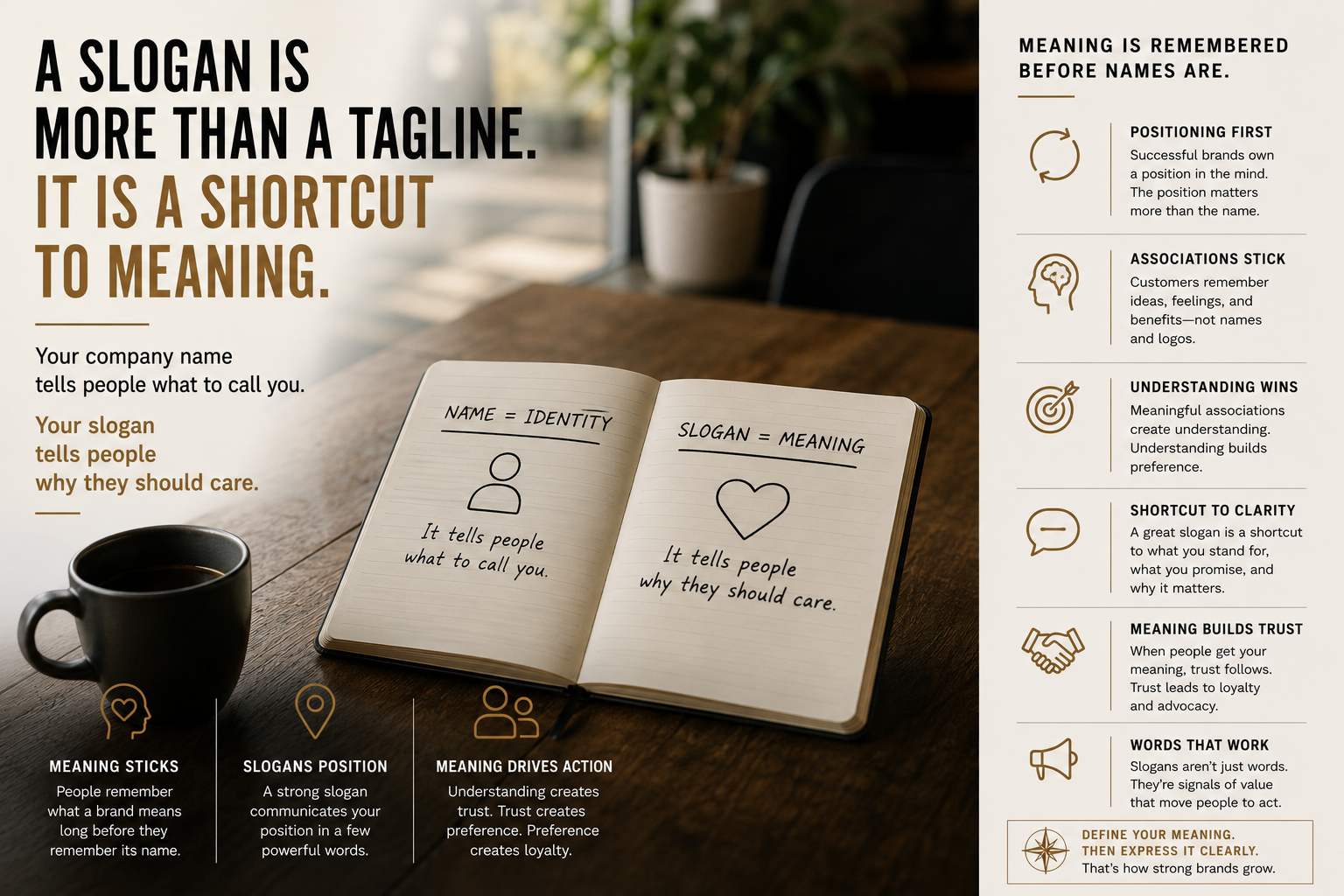
It Is A Shortcut To Meaning
Most business owners spend a great deal of time thinking about their company name; and for good reason. A name is important. It appears on websites, invoices, business cards, storefronts, proposals, and social media profiles.
But there is an interesting question worth asking:
What if customers remember what your company means before they remember what it is called?
Branding research suggests that may be exactly what happens.
Names Identify. Meaning Differentiates.
A company name performs an important function; it identifies. It tells customers what to call you. But a name alone rarely explains why someone should care.
Consider, for a moment, a business name you have never heard before. Without additional context, the name itself tells you very little. What customers actually remember are the associations attached to that name:
Trust
Simplicity
Reliability
Innovation
Hospitality
Craftsmanship
The name becomes a label. The meaning becomes the memory.
This idea aligns closely with positioning theory. In their influential work, Ries and Trout argued that successful brands occupy a distinct position in the consumer's mind. The position itself matters more than the name attached to it. [1]
Customers do not simply remember brands. They remember what brands represent.
The Role of a Slogan
This is where slogans become interesting.
Many businesses treat slogans as decorative additions. Something placed beneath a logo. Something included on a business card. Something written once and forgotten. But the strongest slogans do something much more important; they accelerate understanding.
A slogan compresses an entire positioning strategy into a few words. It gives customers a shortcut, a shortcut to understanding:
What the company values
What it promises
What makes it different
Why it exists
In many ways, a slogan serves as an interpreter. It translates a company name into meaning.
Why Meaning Matters
Brand strategist David Aaker argued that strong brands are built through associations. Consumers do not store brands in memory as names alone. They store ideas, emotions, experiences, and benefits connected to those names. [2]
This helps explain why some slogans become inseparable from the brands they represent. The slogan reinforces the meaning customers already associate with the company. Over time, repetition strengthens the connection. Eventually, the slogan becomes a shorthand version of the brand itself. Not because the words are clever. Because the words communicate something meaningful.
The Difference Between Recognition and Understanding
Many businesses focus exclusively on recognition. They want people to remember the company name. Recognition is valuable but understanding is often more valuable.
Imagine two businesses; the first is recognized and the second is understood.
Customers know what the first company is called. Customers know what the second company stands for. Which one is more likely to earn trust? Which one is more likely to be remembered? Which one is more likely to be recommended?
Kevin Lane Keller's work on customer-based brand equity suggests that strong brands are built by creating meaningful associations in memory. Before loyalty develops, customers must first understand what a brand represents. [3]
Meaning precedes loyalty. Meaning precedes advocacy. Meaning precedes preference.
Why Strong Slogans Endure
The strongest slogans are rarely complicated. They do not attempt to explain everything. Instead, they communicate a single idea exceptionally well.
A slogan works best when it reinforces a position that already exists within the brand. It becomes a reminder rather than an explanation. A signal rather than a statement. A shortcut rather than a story. Because customers do not want to decode brands.
They want to understand them quickly.
What Business Owners Often Miss
Many companies invest heavily in visual branding while spending very little time defining the meaning behind the brand itself. They debate:
Colours
Logos
Typography
Photography
Meanwhile, the more important question often remains unanswered; what should customers associate with this business?
Until that question is answered, even the best visual identity will struggle to create lasting impact.The strongest brands begin with meaning.
Everything else follows.
More Than Words
A slogan is not the brand and yet, it can become one of the most powerful expressions of the brand. This is because a slogan occupies a unique role.
It sits between identity and understanding. Between positioning and perception. Between what a company believes and what a customer remembers.
Your company name tells people what to call you. Your slogan tells people why they should care.
And in branding, meaning is often remembered long before names are.
Selected Research & Reading
[1] Ries, A., & Trout, J. (1981). Positioning: The Battle for Your Mind.
[2] Aaker, D. A. (1996). Building Strong Brands.
[3] Keller, K. L. (1993). Conceptualizing, Measuring, and Managing Customer-Based Brand Equity. Journal of Marketing.