
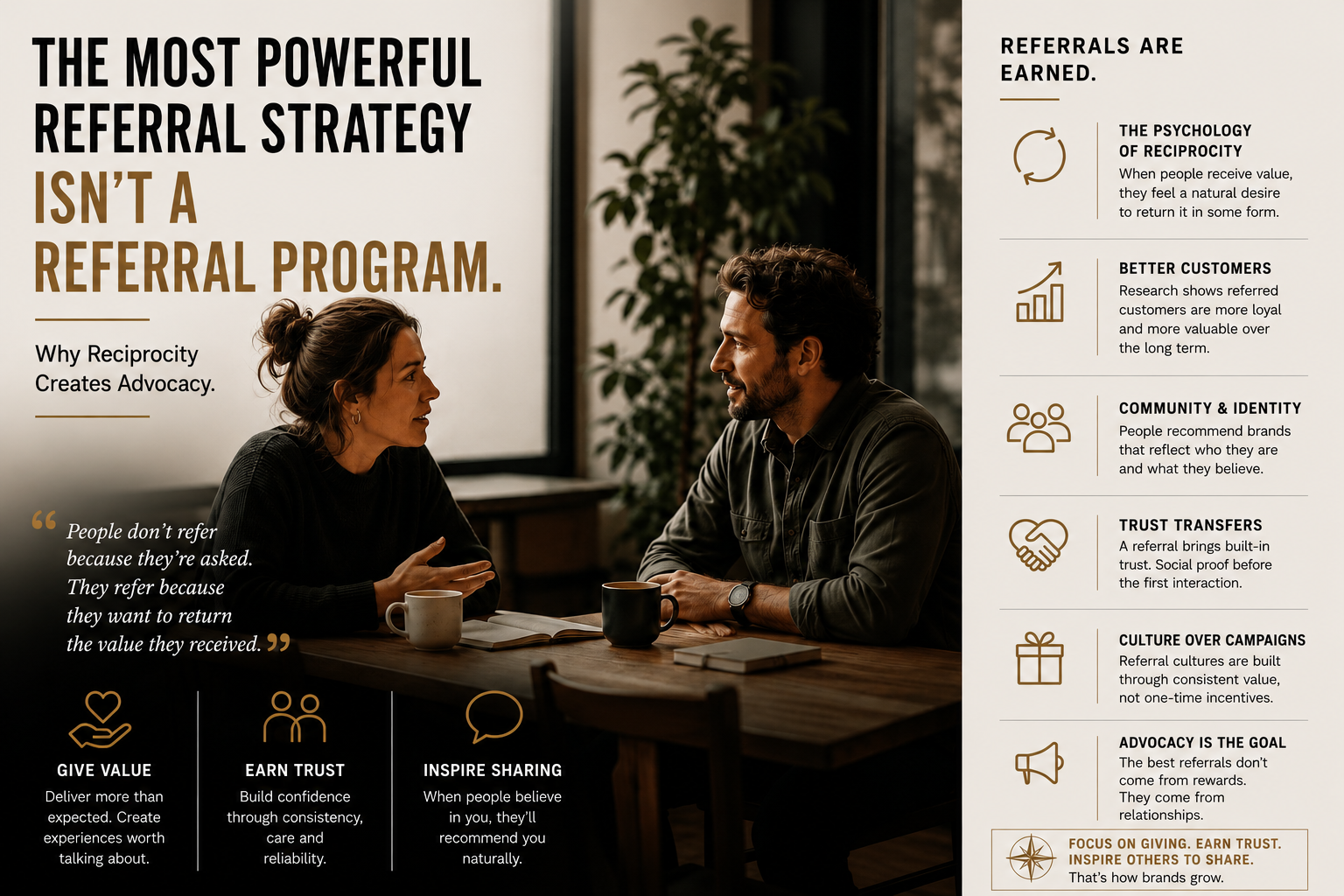
Why Reciprocity Creates Advocacy
When businesses want more referrals the common response is to create a referral program.
Offer a discount. Provide a gift card. Reward customers for introducing friends.
Sometimes it works. Sometimes, maybe more often, it raises an interesting question:
If referrals are something people naturally do when they trust a business, why do so many companies feel the need to pay for them?
Research in psychology and consumer behaviour suggests the answer may lie in a concept known as reciprocity. And understanding reciprocity may fundamentally change how businesses think about referrals.
The Psychology of Reciprocity
In his research on influence and persuasion, Robert Cialdini identified reciprocity as one of the most powerful principles governing human behaviour. Simply put, when people receive something valuable, they often feel a natural desire to return value in some form. [1]
This behaviour appears across cultures and contexts.
People reciprocate:
Favours
Acts of kindness
Hospitality
Advice
Trust
Generosity
And sometimes, they reciprocate through referrals.
This creates an important distinction.
Many businesses view referrals as something they must request. However, research suggests they may be more effectively earned.
Why People Recommend Brands
Most customers do not recommend businesses because they were asked. They recommend businesses because doing so feels good.
Consumer research has found that people often use brands as extensions of their own identity. The brands they recommend communicate something about who they are and what they value. [2]
Think about the last time you enthusiastically recommended:
A restaurant
A contractor
A local business
A product you genuinely loved
Chances are you were not motivated by a reward. You were motivated by confidence. The recommendation became a reflection of your own judgement.
That is advocacy. And advocacy is significantly more powerful than incentive.
What Research Says About Referred Customers
One of the most influential studies on referral marketing followed nearly 10,000 customers at a German bank.
Researchers discovered something remarkable:
Referred customers were not only more likely to join the business, they were also more loyal and generated greater long-term value than non-referred customers. [3]
In fact, referred customers produced substantially higher customer lifetime value.
That finding changes the way we should think about referrals.
A referral is not simply a new customer acquisition channel. It is often a source of better customers.
Why?
Because trust has already been transferred.
The referral acts as social proof before the first interaction ever occurs.
The Difference Between Referral Programs and Referral Cultures
This is where many businesses get stuck. They focus on building referral programs instead of building referral cultures.
Programs and cultures are not the same thing.
A referral program says:
“Refer a friend and receive $25.”
A referral culture says:
“This company has helped me enough that I naturally want others to experience it.”
The first creates transactions.
The second creates advocacy.
Both can work. Only one creates momentum.
Why Brand Communities Matter
Research into brand communities found that customers often form emotional attachments to brands that create a sense of belonging, identity, and shared values. [4]
When customers begin identifying with a brand, recommendations become more than transactions. They become expressions of trust and personal endorsement.
In this way, referrals often function as a form of social currency. People are not merely recommending a product or service. They are attaching their own reputation to the recommendation.
That is one reason advocacy is so valuable and so difficult to manufacture.
The Reciprocity Advantage
Reciprocity creates an interesting challenge for business owners.
Instead of asking:
“How do we get more referrals?”
The better question may be:
“What value are we creating that customers feel compelled to reciprocate?”
The answer is rarely found in a rewards program. Instead, it is often found in:
Exceptional service
Genuine hospitality
Consistency
Thoughtfulness
Trust
Reliability
Unexpected generosity
These things create emotional deposits and over time, those deposits accumulate. Eventually, customers begin paying them back. Sometimes through loyalty. Sometimes through advocacy. Sometimes through referrals.
The Strongest Referrals Are Earned
The most powerful referral strategy is not necessarily a referral program.
It is building a business worth talking about.
People rarely recommend brands simply because they were asked. They recommend brands because doing so feels like the natural response to value received.
That is reciprocity.
And while discounts may generate referrals, reciprocity creates something far more valuable:
Advocates.
Selected Research & Reading
[1] Cialdini, R. B. (2009). Influence: Science and Practice.
[2] Escalas, J. E., & Bettman, J. R. (2005). Self-Construal, Reference Groups, and Brand Meaning. Journal of Consumer Research.
[3] Schmitt, P., Skiera, B., & Van den Bulte, C. (2011). Referral Programs and Customer Value. Journal of Marketing.
[4] Muniz, A. M., & O’Guinn, T. C. (2001). Brand Community. Journal of Consumer Research.