
Why Clear Opposition Creates Stronger Identity
Most businesses spend enormous energy communicating what they stand for.
Quality.
Service.
Innovation.
Trust.
But the strongest brands often become memorable for another reason entirely:
They are also clear about what they stand against.
Not aggressively.
Not politically.
Not performatively.
Strategically.
Academic research surrounding brand positioning and consumer identity has consistently shown that differentiation becomes stronger when brands establish clear symbolic distinctions within a market. In simple terms, people remember brands more easily when those brands represent a recognizable point of view. [1][2]
That distinction matters.
Because brands that attempt to appeal to everyone often become difficult to remember.
Brands Become Clearer Through Contrast
Consumers rarely evaluate brands in isolation.
They evaluate them comparatively.
A brand becomes recognizable when customers instinctively understand:
What it values
What it prioritizes
What it refuses to compromise on
In branding theory, this is often connected to positioning and identity signaling. Researchers have found that consumers gravitate toward brands that reinforce their own self-image, beliefs, and lifestyle preferences. [2][3]
This is where opposition becomes powerful.
Every memorable brand quietly rejects something.
Canadian Brands That Built Identity Through Opposition
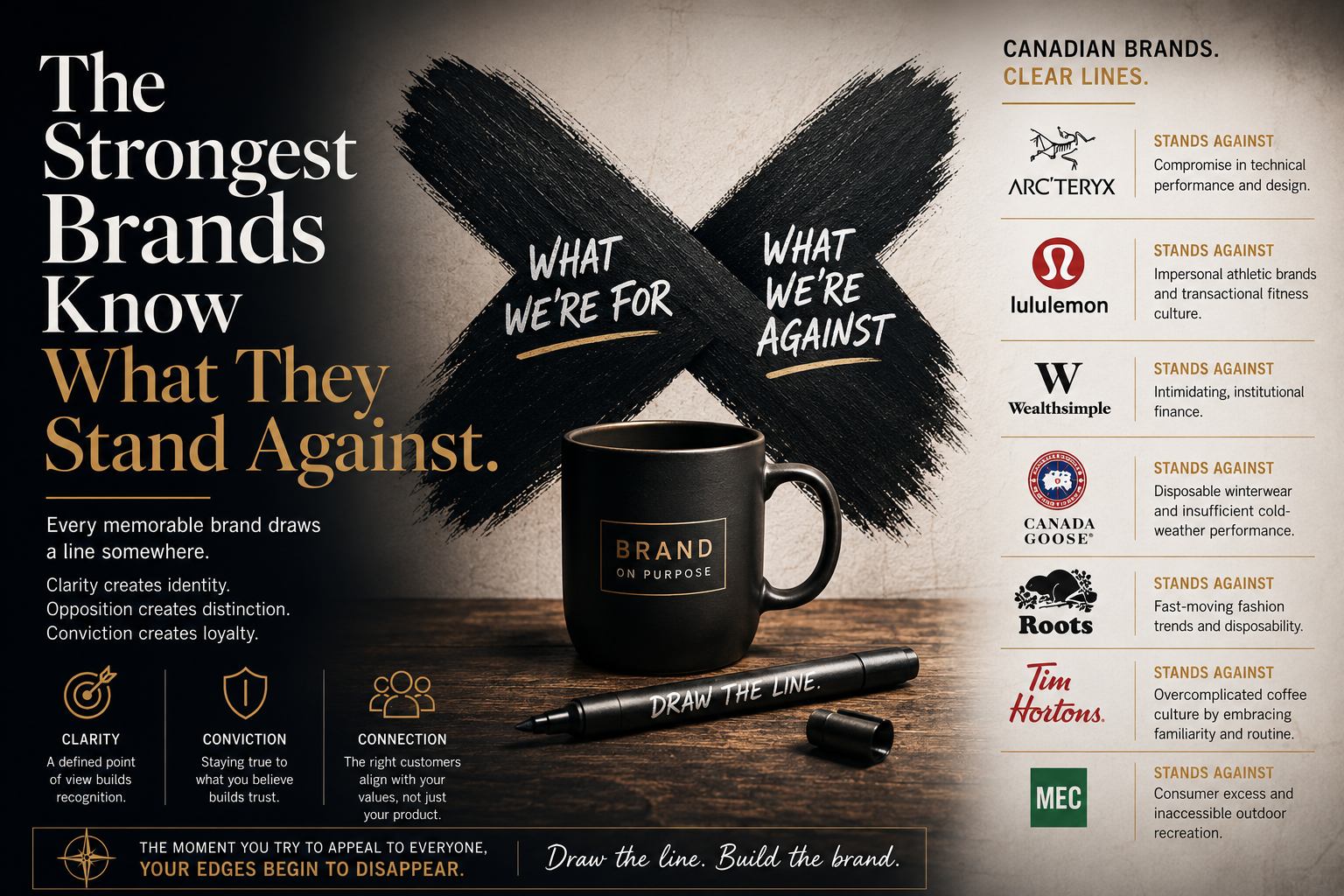
Arc’teryx did not become globally respected by chasing mass-market outdoor fashion. The brand built its reputation through technical precision, minimalist design, and uncompromising performance. In many ways, it positioned itself against disposable outdoor gear culture and trend-driven performance wear.
Lululemon originally differentiated itself by standing against impersonal athletic retail environments. The company emphasized community, wellness culture, local ambassadors, and experiential retail long before many competitors adopted similar strategies.
Wealthsimple built much of its early identity by positioning itself against intimidating institutional finance. Simplicity, accessibility, and modern communication became strategic contrasts within a traditionally formal industry.
Canada Goose developed a reputation by rejecting compromise in extreme-weather performance. The brand did not market itself as fashionable first. It built credibility through utility, endurance, and harsh-climate functionality.
Even brands rooted in heritage, like Roots, quietly positioned themselves against fast-moving fashion culture through comfort, familiarity, and timelessness.
None of these brands succeeded by trying to become everything to everyone.
They became recognizable because they drew clear lines somewhere.
The Risk of Trying to Appeal to Everyone
Many companies weaken their identity by over-expanding their positioning.
They attempt to:
Target every demographic
Follow every trend
Match every competitor
Avoid excluding anyone
But strong brands often require selective focus.
Research in consumer psychology has repeatedly shown that distinctiveness improves memory retention and emotional association. [1]
In practice, this means clarity matters more than broadness.
A brand with a strong point of view may attract fewer people initially, but the customers it does attract often become significantly more loyal.
Opposition Creates Cultural Alignment
What a brand stands against often shapes its internal culture just as much as its external positioning.
A hospitality company that stands against friction behaves differently.
A premium car wash that stands against inconvenience operates differently.
A luxury builder that stands against generic design develops differently.
Over time, these decisions compound into culture.
And culture becomes visible through repetition:
Service standards
Hiring
Communication
Attention to detail
Customer interaction
Product development
Researchers studying organizational identity have found that companies with strong internal alignment tend to produce stronger external brand consistency. [4]
Customers may never read a company’s mission statement, but they absolutely notice behavioural consistency.
Conviction Builds Trust
Consumers are increasingly exposed to thousands of marketing messages every day.
Most disappear immediately.
The brands that endure are often the ones that communicate conviction clearly enough that customers instinctively understand what the company believes.
That does not require controversy.
It requires clarity.
Because the moment a brand tries to appeal to everyone, its edges begin to disappear.
And in branding, edges are often what make companies memorable.
The Brands People Remember
The strongest brands rarely become successful because they say more.
They become successful because they stand for something specific enough that customers can feel it.
And often, that identity becomes clearest through contrast.
Not through what the company includes.
But through what it intentionally refuses to become.
Selected Research & Reading
[1] Ries, A., & Trout, J. (1981). Positioning: The Battle for Your Mind.
[2] Escalas, J. E., & Bettman, J. R. (2005). Self-Construal, Reference Groups, and Brand Meaning. Journal of Consumer Research.
[3] Muniz, A. M., & O’Guinn, T. C. (2001). Brand Community. Journal of Consumer Research.
[4] Hatch, M. J., & Schultz, M. (2001). Are the Strategic Stars Aligned for Your Corporate Brand? Harvard Business Review.