
What Is Your Marketing Supposed to Do?
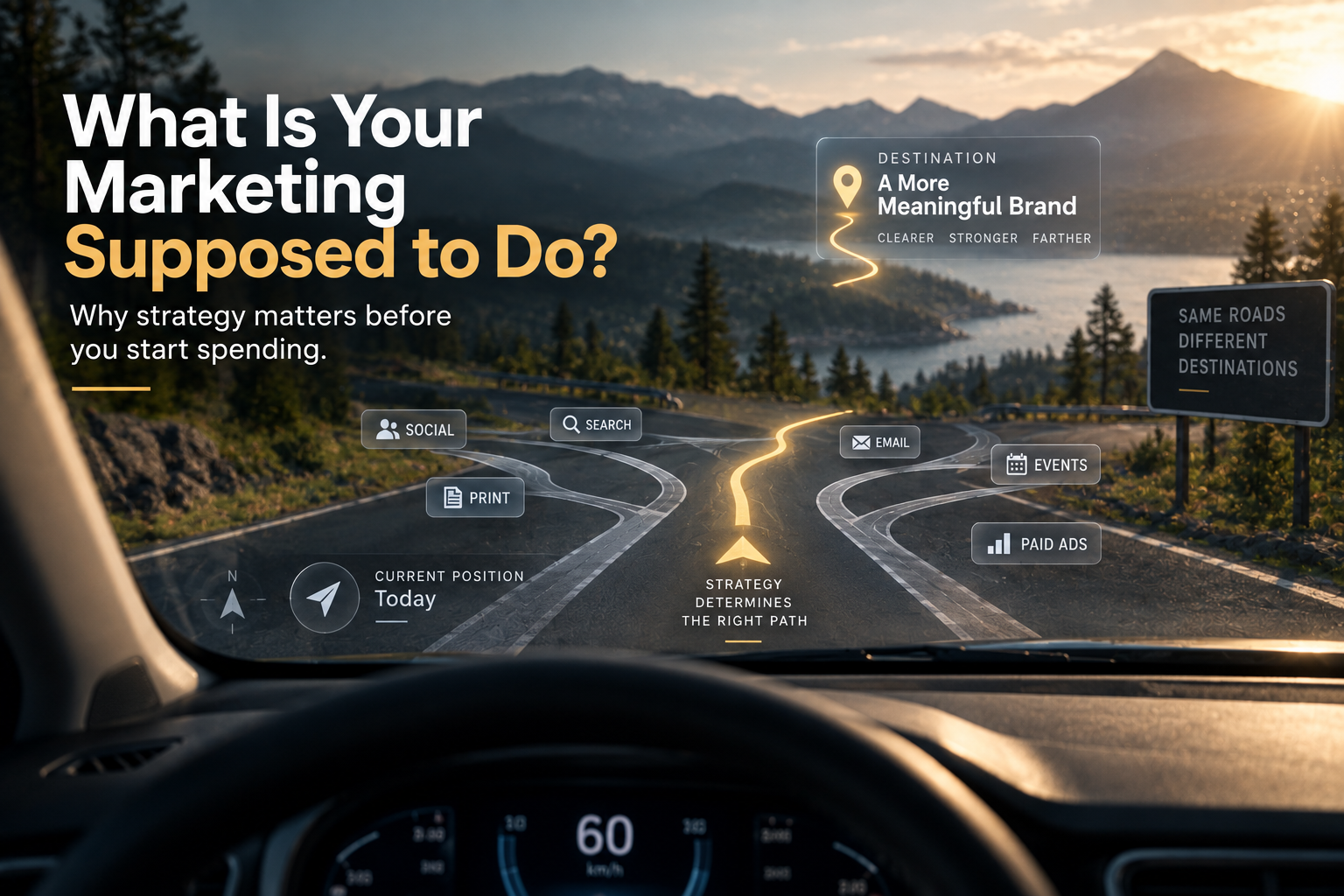
Why strategy matters before you start spending
Imagine being handed a treasure map without knowing what the treasure is. You could follow the path, dig where the map tells you to dig, and even move very quickly. If you're following the map, you know you're getting closer. The question is whether the treasure is worth your time.
Marketing can work in much the same way. Businesses are often quick to ask what they should do. Should we run Google Ads? Should we be on Instagram? Should we send an email campaign? Should we sponsor this event? Should we redesign the website? Should we print something and put it in people's mailboxes?
These are reasonable questions, but they aren't necessarily the first questions we should be asking.
Before deciding what marketing should do, we need to know what the marketing is supposed to accomplish. What is the goal?
That's where strategy comes in. Strategy is the map. It gives the journey direction without requiring us to know every step we'll take along the way.
Marketing Can Become Very Busy Very Quickly
It's surprisingly easy for a business to become busy with marketing. There are always things that can be done: a social post can be created, an advertisement can be launched, a sponsorship opportunity can be considered, a website can be updated, a brochure can be printed, or an email can be sent. Because each activity can appear productive on its own, it can be tempting to keep adding more.
But activity isn't necessarily progress. A business can be doing a great deal of marketing without having a clear understanding of what all that marketing is supposed to accomplish. That's the distinction between tactics and strategy. Tactics are the things we do; strategy gives those things a reason.
Research supports the importance of this distinction. In a study of small and medium-sized businesses, O'Cass, Ngo and Siahtiri found that marketing planning capability improved marketing implementation capability, which in turn supported customer-centric performance, including customer attraction and retention. Their findings suggest that planning matters not simply because a business has a plan, but because planning can help translate marketing thinking into action. [1]
The value of strategy isn't the document. It's what the clarity allows the business to do.
Strategy Is the Map, Not the Journey
A good map doesn't tell you exactly what will happen on the way to the destination. There might be a fallen tree across the path, a bridge might be out, or you might discover a better route along the way. The map doesn't eliminate those possibilities. It gives you a destination and enough information to make better decisions as you move.
Marketing strategy should work in much the same way. It should help establish who we're trying to reach, what we want them to understand, what makes us meaningfully different, what position we want to occupy in their minds, and what we're actually trying to accomplish. It should also help us determine which channels are appropriate for the job, how those channels should work together, and how we'll know whether we're moving in the right direction.
Those decisions don't need to predict every marketing activity that will happen over the next year. They provide a point of reference for making those decisions as circumstances change. In that sense, one of the most valuable things strategy does is give the next decision somewhere to come from.
Strategy Shouldn't Create Paralysis
There is an important caveat here. Strategy can become too much of a good thing.
There is a tendency to believe that the more detailed the plan, the better the strategy. But research has identified what Slotegraaf and Dickson describe as a planning paradox. Strong marketing planning can provide benefits, but planning can also introduce rigidity and reduce the amount of improvisation available to a business. [2]
That's important because markets don't sit still while a strategy is being implemented. Customers change, competitors change, technology changes, and opportunities appear that weren't visible when the plan was written. Things that seemed important six months ago may become less important tomorrow.
The answer isn't less strategy. It's better strategy.
A strategy should create clarity without creating a cage. It should tell us what matters while leaving enough room to respond to what happens next. We don't need to know every turn of the road. We need to know where we're going.
The purpose of strategy isn't to keep a business standing over a map trying to calculate every possible move. The purpose is to give the business enough confidence in its direction to start driving.
Before Choosing the Channel, Choose the Job
One of the easiest ways for marketing to lose its direction is to start with the channel. We should be on Instagram. We should try Google. We should do some radio. Everyone is using video now.
The problem isn't that any of these ideas are necessarily wrong. The problem is that they begin with the how before answering the why.
The better question is: What job do we need marketing to do?
If the objective is to build awareness within a local market, the answer may look very different than if the objective is to capture people who are already searching for a particular service. If the objective is to change how a business is perceived, the strategy may look different again. If the objective is to retain existing customers, an entirely different set of tools may make sense.
The channel comes later. First comes the job.
Once the objective and audience are clearer, individual marketing opportunities become easier to evaluate. A new advertising opportunity isn't simply good or bad; it can be considered against the strategy. Does it help us get where we're trying to go? If it does, it may have a role. If it doesn't, perhaps it isn't the right opportunity, regardless of how attractive it may appear on its own.
Strategy Helps Connect the Pieces
Good marketing rarely happens through one isolated activity. A website might introduce the brand. Search might capture existing demand. Social might reinforce familiarity. Email might develop an existing relationship. A sign might build recognition. A sponsorship might establish local presence. A sales conversation might turn interest into action.
Each of these can have a legitimate role, but the problem occurs when those roles aren't connected. One message says one thing while another says something different. The website positions the company one way while the advertising positions it another. Marketing is happening, but the pieces aren't necessarily moving in the same direction.
This is where strategy becomes more than a document. It becomes the connection between decisions.
Research examining marketing resources and capabilities reinforces this idea. Ngo and O'Cass examined the relationship between market orientation, marketing resources and marketing capabilities, finding that the way firms develop and deploy their marketing capabilities has important performance implications. [3] Having resources available isn't the same thing as having the capability to use them effectively.
A business doesn't necessarily need more marketing activity. Sometimes it needs better coordination between the activity it already has.
Strategy Doesn't Guarantee the Right Answer
This is worth saying because strategy is sometimes presented as though it can eliminate uncertainty. It can't.
There is no strategy that can guarantee every campaign will work, every customer will respond, or every marketing decision will be correct. Markets are too complicated for that, and no plan can account for every variable that might influence a business.
Recent research into marketing strategy implementation highlights just how difficult it can be to translate strategic decisions into coordinated action. Morgan and colleagues examine why strategy implementation remains difficult for organizations, emphasizing the challenges involved in turning strategic intent into actual organizational behaviour and resource deployment. [4]
That shouldn't discourage us from having a strategy. It should make us more thoughtful about what we expect strategy to do.
Strategy doesn't eliminate uncertainty. It gives us a way to navigate it.
It gives us something against which decisions can be evaluated. It gives teams a shared understanding of what they're trying to accomplish. And it makes it easier to recognize when something has stopped serving the original objective.
The Goal Isn't to Spend Less. It's to Know Why You're Spending.
This is where the conversation about marketing investment becomes particularly important.
A marketing budget isn't a strategy. Neither is a list of tactics. And spending less isn't necessarily the objective. The better question is: What is this investment supposed to accomplish?
That changes the conversation. Instead of asking whether a campaign is expensive, we can ask what it is supposed to achieve. Instead of asking whether a sponsorship is a good deal, we can ask what role the sponsorship is expected to play. Instead of asking whether a business should be on a particular platform, we can ask whether that platform helps accomplish something the strategy requires.
This doesn't make every decision easy, but it makes decisions more intentional. We can evaluate opportunities against something bigger than the opportunity itself.
A 2026 meta-analysis synthesizing 83 empirical studies found positive relationships between strategic marketing and customer, financial and operational performance, while also highlighting that these relationships depend on context and the specific marketing capabilities involved. [5]
The research doesn't suggest that strategy is a magic formula. It suggests something more practical: how a business thinks about and deploys marketing matters.
The Map Doesn't Need to Be Perfect
Perhaps the biggest misconception about strategy is that we need to have everything figured out before we begin.
We don't.
A map can be incomplete and still be useful. We can know our destination without knowing every road we'll take. We can know who we're trying to reach without knowing exactly how they'll respond. We can understand our position in the market while remaining open to discovering something new. And we can make a decision today while knowing we may need to adjust it tomorrow.
In fact, flexibility is part of good strategy. The purpose isn't to create a document that tells a business exactly what to do forever. The purpose is to create enough clarity to make better decisions now and better decisions when circumstances change.
That's very different from analysis paralysis.
We don't need to sit over the map until we've memorized every detail. We need to understand the destination, identify the best path available to us, and start moving.
The map gives us confidence to act without pretending we can predict everything that will happen.
What Is Your Marketing Supposed to Do?
Perhaps that's the question worth asking before the next campaign, advertisement or marketing investment.
Not What should we post? Not What platform should we use? Not What are our competitors doing? And not even What's everyone else spending money on?
Start somewhere earlier.
What are we trying to accomplish?
Who are we trying to reach? What do we want them to understand? What should make us the right choice? What needs to change? And what role should marketing play in getting us there?
Once those answers become clearer, the tactics have somewhere to go. A campaign becomes more than a campaign. A channel becomes more than a channel. A marketing investment becomes part of something larger.
The map begins to make sense.
What This Study Teaches Us
Strategy isn't about knowing everything that will happen. It's about knowing what we're trying to accomplish before deciding what to do next.
The research points to a useful balance. Marketing planning can strengthen implementation and customer performance, but planning can also become restrictive when it creates too much rigidity. Strategic marketing can contribute to business performance, but only when strategy is translated into action. [1][2][4][5]
So perhaps good strategy isn't about creating a perfect plan.
It's about creating a useful map; one that tells us where we're going, helps us understand the landscape, gives our decisions some context and still leaves room to change course when the terrain changes.
We may not know exactly what we'll encounter along the way. We may even discover that the destination isn't what we thought it was.
But at least we know where we're going and we can then decide whether it's worth the journey.
Selected Research & Reading
[1] O'Cass, A., Ngo, L. V., & Siahtiri, V. (2012). Examining the marketing planning–marketing capability interface and customer-centric performance in SMEs.Journal of Strategic Marketing, 20(6), 463–481.
[2] Slotegraaf, R. J., & Dickson, P. R. (2004). The Paradox of a Marketing Planning Capability.Journal of the Academy of Marketing Science, 32(4), 371–385.
[3] Ngo, L. V., & O'Cass, A. (2012). Performance implications of market orientation, marketing resources, and marketing capabilities.Journal of Marketing Management, 28(1–2), 173–187.
[4] Morgan, N. A., Menon, A., Jaworski, B. J., & Musarra, G. (2025). Marketing strategy implementation: Why is it so hard? Journal of Business Research, 190, 115231.
[5]The dynamics and contingencies of marketing and business performance relationship: A meta-analysis. (2026). European Research on Management and Business Economics, 32(3), 100321.