
When Advertising Has Limits
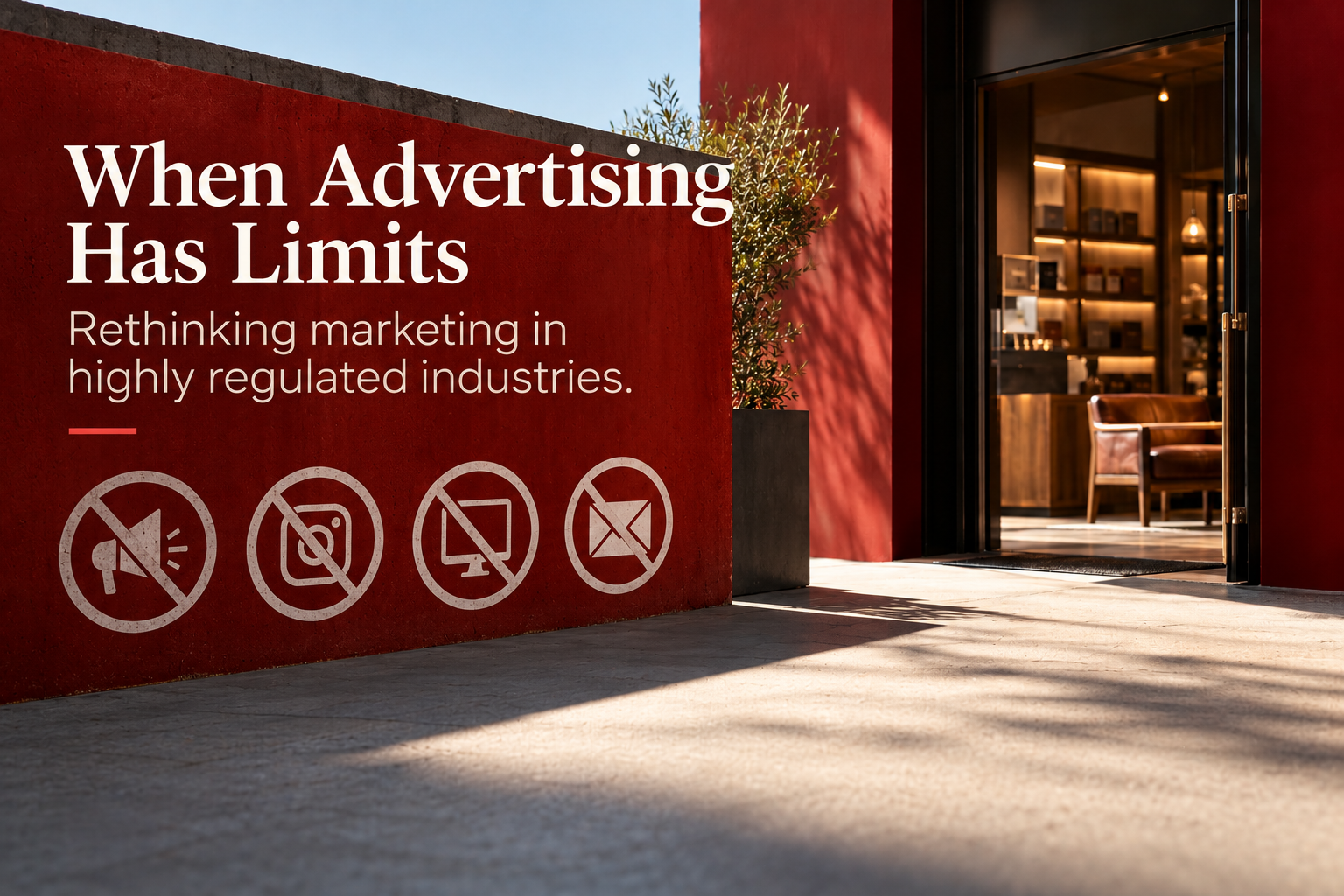
Rethinking marketing in highly regulated industries
Advertising is often treated as one of the fundamental building blocks of marketing. Decide who you want to reach, choose the channels that can reach them, create the message, put some money behind it, and measure what happens.
But what happens when some of those channels aren't available?
For businesses operating in highly regulated industries, this isn't a theoretical question. Regulations can place significant limits on what can be said, where it can be said, how it can be communicated, and sometimes even who can be reached. The specific rules vary considerably by industry and jurisdiction, but the strategic problem is similar: what do you do when the usual tools of advertising are no longer available to you?
It is tempting to treat this as a media problem. Find another channel. Move the budget somewhere else. Find a different way to get the message in front of people.
Maybe that isn't the most useful question.
Maybe the better question is: what happens when you can no longer rely on advertising to do the work for you?
When the channel becomes the strategy
Marketing has become increasingly associated with channels. Search. Social. Email. Display. Video. Direct mail. Influencers. Paid media. The list continues to grow.
Since these channels are measurable, they can become particularly seductive. We can see impressions, clicks, conversions and acquisition costs. We can compare one campaign against another. We can optimize the creative, adjust the audience and move the budget.
None of this is inherently wrong. Advertising can be an important source of awareness, information and competition. The Competition Bureau of Canada, for example, recognizes that advertising can help consumers understand their choices and allow businesses to communicate meaningful differences between their offerings.[3]
The problem begins when the channel becomes the strategy.
If the goal is awareness, we shouldn't begin by asking which advertising platform to use. If the goal is consideration, we shouldn't immediately jump to the latest available media format. And if the goal is preference, we shouldn't assume that buying more attention will necessarily create it.
The objective comes first. The channel comes later.
That distinction becomes particularly important when regulation removes some of the channels we might normally reach for. The job hasn't disappeared. The tools have changed.
Constraints change the question
There is also an important distinction between disagreeing with a regulation and understanding the strategic environment created by it.
Advertising restrictions exist for different reasons and vary considerably across industries. In some regulated professions, for example, restrictions have historically been associated with concerns about misleading claims or information that consumers may have difficulty evaluating for themselves. The Competition Bureau's examination of advertising restrictions in Canadian health-care professions discusses precisely this tension: consumers need information to make informed choices, while regulators may have legitimate reasons to restrict certain forms of communication.[3]
The point isn't whether regulation is good or bad. That's a much larger question.
The strategic question is simpler: given the environment in which the business operates, how should the business build awareness, trust and preference?
That change in perspective matters.
A restriction can be viewed as a barrier, or it can be treated as a strategic constraint. Constraints, while rarely convenient, can sometimes force better thinking.
When a business can't simply purchase attention, it has to think more carefully about how attention is earned.
So look inward
If you can't rely as heavily on advertising, where does marketing come from?
It may come from the business itself.
Your people become more important. Your expertise becomes more important. Your customer experience becomes more important. Your physical environment becomes more important. Your reputation becomes more important. The way you answer a question, solve a problem, welcome someone through the door or explain what you do can suddenly carry more weight.
This isn't a new idea. Customer experience research has increasingly recognized that customers interact with businesses across a complex collection of touchpoints and channels, and that the experience is shaped by much more than a single marketing communication.[1]
When advertising is doing less of the heavy lifting, those touchpoints become harder to dismiss as simply operational.
They become part of the marketing.
A knowledgeable employee can create confidence. A thoughtful environment can reinforce positioning. A useful conversation can create trust. A consistent experience can make a brand easier to remember. A customer who feels genuinely looked after may tell someone else about the experience.
None of those things looks much like an advertisement.
That doesn't make them any less important to marketing.
The customer becomes part of the media
One of the most interesting consequences of this is that the customer can become a more important part of how a business grows.
Customers don't simply buy. They talk. They recommend. They write reviews. They help other customers. They share experiences. They create content. They answer questions. They tell people where they went and what happened when they got there.
Researchers have described these behaviours as customer engagement behaviours; actions that extend beyond the purchase itself, including word-of-mouth, recommendations, reviews and other forms of interaction with a brand.[2]
This doesn't mean businesses should try to manufacture word-of-mouth.
In fact, trying too hard to make people talk about you can have the opposite effect.
A better approach is to create something worth talking about.
That might be an unusually knowledgeable team. It might be a genuinely helpful experience. It might be a physical space that feels different from the category. It might simply be a business that consistently does what it says it will do.
When people have a reason to remember you, they have a reason to mention you.
And unlike an advertisement, that recommendation arrives through a relationship that already exists.
Expertise can become a marketing asset
Highly regulated industries often contain something else that is easy to overlook: expertise.
The business may know considerably more about its category than the average customer does. That knowledge can become an important source of value; not necessarily because it is turned into promotional content, but because it can be used to make customers feel more informed and more confident.
There is a meaningful difference between saying, “We're experts,” and demonstrating expertise; one is a claim and the other is an experience.
A business that can answer difficult questions clearly, explain complicated things without talking down to people, help customers make better decisions and demonstrate genuine command of its field is doing something that advertising alone cannot easily accomplish.
It is building credibility through interaction. Credibility that can travel.
The brand has to work harder
This is where branding becomes particularly important.
When a business has fewer opportunities to tell people who it is through advertising, the brand has to communicate through more of the things it can control. Things like its name, its visual identity, its environment, its people, its tone of voice, its website, its packaging, its service, its expertise, its response to problems, and its consistency; just to name a few.
Every one of these becomes another opportunity to reinforce what the business stands for.
This is one reason we think branding and marketing are so closely connected. Branding establishes the meaning a business wants to own. Marketing creates opportunities for that meaning to be encountered. When advertising is restricted, the opportunities may change but the underlying need doesn't.
The brand still needs to be recognized. It still needs to mean something. It still needs to give people a reason to choose it. In fact, the constraint may make those things even more important.
Looking beyond advertising doesn't mean looking for loopholes
There is an important distinction here. If advertising is restricted, the answer isn't necessarily to find a technicality that allows the business to behave as though the restriction doesn't exist. That isn't strategy.
Moving from one communication channel to another doesn't automatically remove regulatory obligations. In Canada, for example, the Competition Act's provisions concerning misleading representations can apply broadly to promotional activity, including printed and electronic advertisements, written or oral representations, illustrations and audio-visual promotions.[4]
So the objective shouldn't be to ask, “How can we get around the rules?” It should be: “Given the rules, what can we build?”
That is a much more interesting question.
Marketing doesn't have to mean more advertising
The biggest lesson is that marketing and advertising aren't interchangeable. Advertising is a tool within marketing. It can help create awareness. It can communicate an offer. It can introduce a business to people who don't know it exists. But advertising doesn't create every asset a business needs to grow.
It doesn't create expertise. It doesn't create culture. It doesn't automatically create trust. It doesn't fix a poor customer experience. It doesn't make a weak brand meaningful. And it certainly can't make a business worth talking about. These things have to be built somewhere else.
When advertising becomes less available, the temptation may be to search for a replacement advertising channel. But what is actually needed is a stronger marketing system; one in which the business itself is doing more of the communicating.
The opportunity hidden inside the constraint
There is something interesting about constraints. They can reveal what was carrying the strategy all along.
If a business loses access to a major advertising channel and suddenly has nothing else to say, maybe the problem was never really the channel. Maybe the business had become too dependent on paid attention.
A business with strong positioning, knowledgeable people, a compelling customer experience and a reputation worth protecting has more options. It can educate. It can build relationships. It can create useful experiences. It can become known within its community. It can encourage customers to talk about it. It can make every interaction reinforce the same underlying idea.
None of this means advertising doesn't matter. It just means advertising isn't the whole story.
And maybe that's the most useful way to think about highly regulated industries.
The restriction may limit how a business communicates, but it doesn't necessarily limit the number of ways a business can create meaning. In some cases, it may actually force the business to become better at doing exactly that.
What This Study Taught Us
When advertising has limits, the answer isn't necessarily to find another place to advertise.
The first step is to step back and reconsider what the marketing is supposed to accomplish. Build awareness. Build consideration. Build trust. Build preference. Build relationships.
Then ask which parts of that work can be done through the brand itself.
Your people can communicate. Your expertise can communicate. Your customer experience can communicate. Your environment can communicate. Your reputation can communicate. Your customers can communicate. And, most importantly, your business can give people something worth communicating about. You can't always buy attention. Sometimes you have to earn it.
So here's the question we were left with: if you couldn't advertise tomorrow, what would your business have left to say?
Selected Research & Reading
[1] Lemon, K. N., & Verhoef, P. C. (2016). Understanding customer experience throughout the customer journey. Journal of Marketing, 80(6), 69–96.
[2] van Doorn, J., Lemon, K. N., Mittal, V., Nass, S., Pick, D., Pirner, P., & Verhoef, P. C. (2010). Customer engagement behavior: Theoretical foundations and research directions. Journal of Service Research, 13(3), 253–266.
[3] Competition Bureau Canada. (2016). Advertising Restrictions. Government of Canada.
[4] Competition Bureau Canada. Misleading representations and deceptive marketing practices. Government of Canada.