
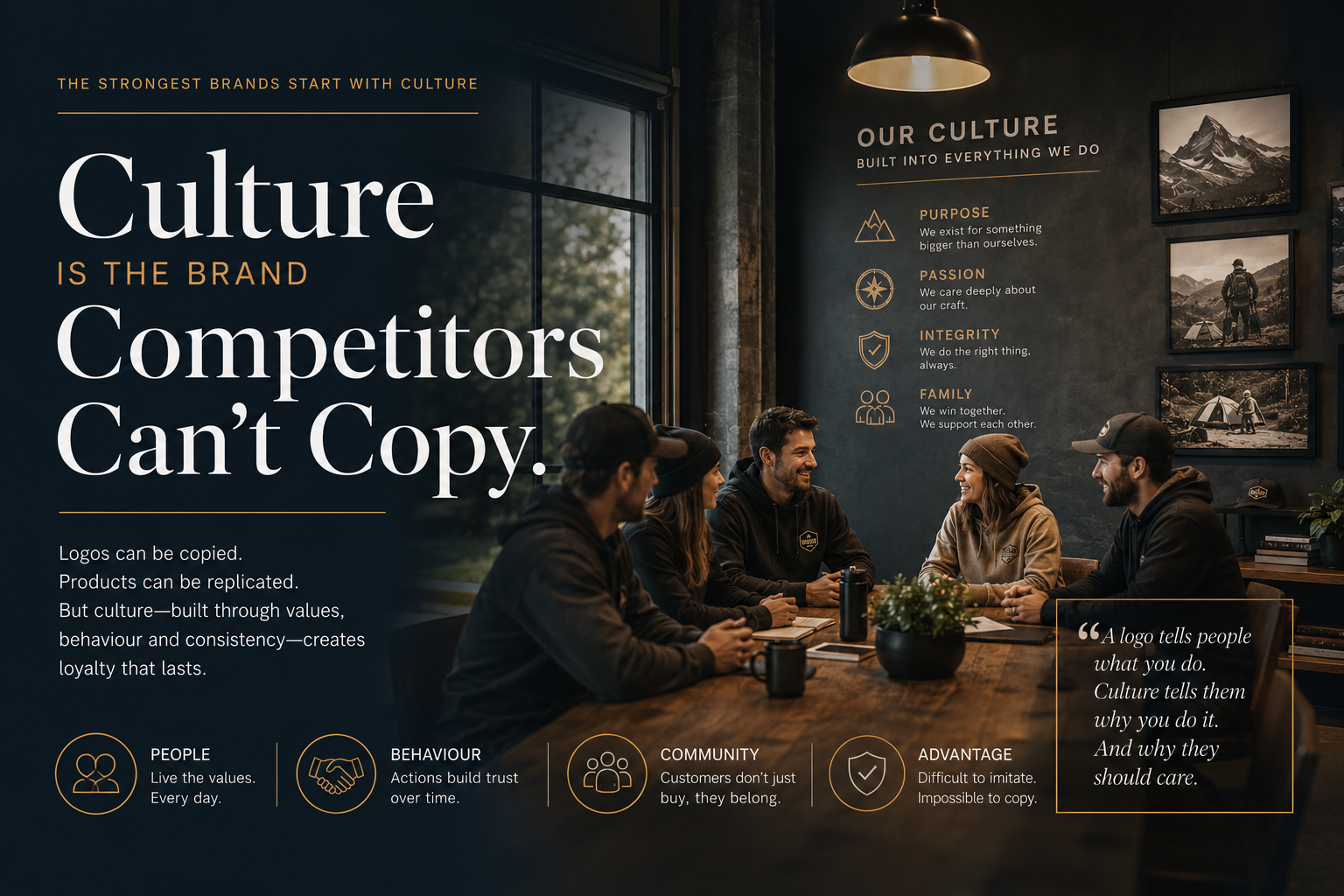
The Strongest Brands Start With Culture
Competitors can copy your product.
They can imitate your pricing, your advertising style, your architecture, and even your visual identity.
But culture is different.
Culture compounds slowly. It develops through leadership, behaviour, repetition, customer interaction, hiring decisions, internal standards, and shared values over time.
And because of that, culture is one of the few remaining competitive advantages that is genuinely difficult to replicate.
Academic research increasingly supports this idea. Studies on organizational culture and internal branding consistently show that customer perception is heavily influenced by employee behaviour, company values, and organizational consistency; not simply logos or marketing campaigns. Researchers within service industry branding have repeatedly found that employees often become the “living expression” of a brand through daily customer interaction. [1][3][5]
In other words:
Customers often experience culture long before they consciously recognize branding.
Branding Is Not Just Visual
Many businesses approach branding as a design exercise.
They focus on:
Logos
Fonts
Colour palettes
Websites
Packaging
Advertising
Those things matter. Yet they are ultimately surface-level expressions of something deeper.
The strongest brands feel consistent because the internal culture behind them is consistent.
Research into organizational culture has shown that employee alignment with company values directly affects customer trust, service quality, and overall brand perception. Studies surrounding internal branding and service organizations have also found that customers are more likely to develop trust in brands when employee behaviour consistently reflects the company’s stated values. [3][4][5]
This helps explain why some companies feel remarkably different even when they sell similar products.
Culture Creates Emotional Gravity
Strong brands rarely compete on utility alone.
They create identity.
Consumer research surrounding “brand communities” has shown that people often build emotional attachment to brands that reflect their values, lifestyle, and social identity. The product itself becomes secondary to what participation in the brand represents. [2]
Consider Patagonia. Customers are not simply purchasing jackets. They are participating in a culture built around environmental responsibility, durability, and anti-consumerism.
Apple built a culture around simplicity, design obsession, creativity, and emotional attachment to technology. Competitors have replicated features for years, yet Apple’s cultural positioning remains extraordinarily resilient.
YETI did not build loyalty through coolers alone. The company built a culture around rugged outdoor identity, storytelling, authenticity, and lifestyle association.
An especially interesting modern example is Montana Knife Company.
Compared to legacy brands like Patagonia or Apple, Montana Knife Company is still relatively young. Yet despite its age, the company has developed an unusually strong cultural identity around craftsmanship, hunting, discipline, American manufacturing, and family-style loyalty.
The products themselves matter, but much of the brand’s strength comes from the feeling surrounding ownership.
Customers often speak about the company less like a manufacturer and more like a community. The brand language, storytelling, founder visibility, product scarcity, and customer interaction all contribute to a sense of belonging that extends beyond the knives themselves.
Owning the product begins to feel like participation in the culture.
That is where branding becomes significantly more difficult to imitate.
Why Culture Is So Difficult to Copy
Products can be reverse engineered.
Culture cannot.
A competitor can imitate:
Your pricing
Your website
Your packaging
Your physical layout
Your marketing language
But replicating years of trust, behavioural consistency, employee standards, customer rituals, and emotional identity is significantly harder.
This idea is echoed throughout organizational behaviour research. Cultural systems inside companies are often described as socially complex and deeply embedded, making them resistant to duplication by competitors. [4]
This is why businesses with strong internal cultures often maintain loyalty even when competitors offer lower prices or similar products.
Culture creates emotional gravity.
It gives customers a reason to stay beyond convenience alone.
The Hospitality Lesson
Hospitality businesses often demonstrate this principle better than almost any other industry.
Two hotels may offer similar rooms, similar amenities, and similar pricing, yet the customer experience can feel entirely different.
Why?
Because culture shapes behaviour.
It influences:
Attention to detail
Employee tone
Service recovery
Warmth
Energy
Consistency
Standards
Research within hospitality management has consistently shown that organizational culture directly influences guest satisfaction, employee engagement, and long-term customer loyalty. [3][4]
Customers may not consciously identify culture during a transaction, but they absolutely feel its effects.
The same principle increasingly applies to modern service businesses like car washes.
The strongest operators are no longer selling “a wash.” They are selling consistency, ease, hospitality, routine, and trust.
That experience is cultural long before it is operational.
Culture Is What Happens Repeatedly
Many businesses treat culture as motivational language displayed on walls.
Real culture is behavioural.
It is what happens repeatedly inside an organization when leadership is not watching.
It is how problems are handled. How customers are spoken to. How employees treat one another. How standards are maintained under pressure.
Over time, customers begin to recognize those patterns.
And eventually, those patterns become the brand itself.
The Brands That Last
The businesses that endure for decades are rarely built on aesthetics alone.
Visual identity helps customers recognize a brand.
Culture gives them a reason to trust it.
That distinction matters.
Because while competitors may eventually imitate what your company looks like, they will struggle to imitate what your company feels like.
And in modern branding, feeling is often the part customers remember most.
Selected Research & Reading
[1] Hatch, M. J., & Schultz, M. (2001). Are the Strategic Stars Aligned for Your Corporate Brand? Harvard Business Review.
[2] Muniz, A. M., & O’Guinn, T. C. (2001). Brand Community. Journal of Consumer Research.
[3] Punjaisri, K., & Wilson, A. (2011). Internal Branding Process: Key Mechanisms, Outcomes and Moderating Factors. European Journal of Marketing.
[4] Schein, E. H. (2010). Organizational Culture and Leadership.
[5] King, C., & Grace, D. (2008). Internal Branding: Exploring the Employee’s Perspective. Journal of Brand Management.