
What Aaker and Joachimsthaler Got Right; and How It Shows Up in Modern Brand Portfolios
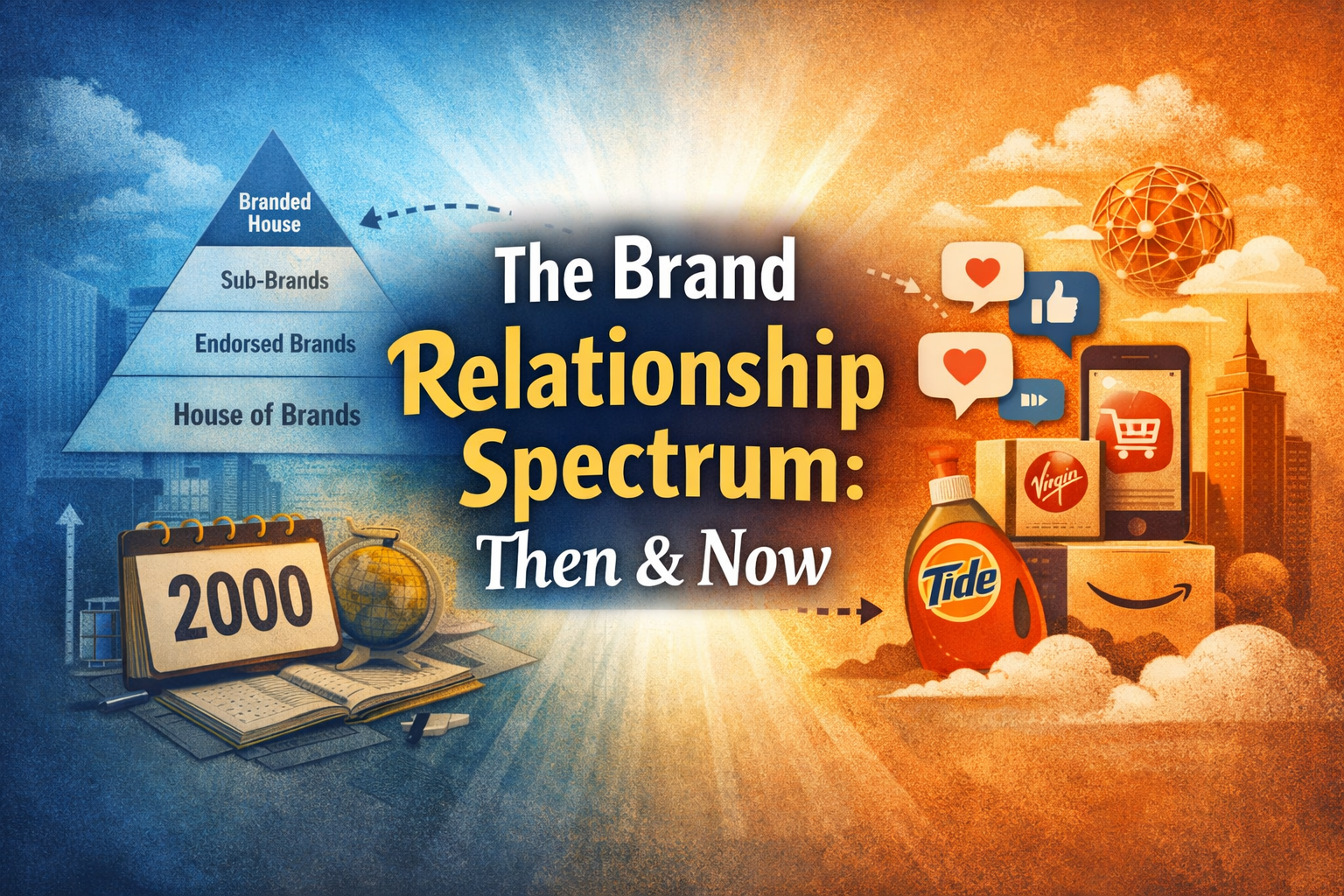
In 2000, David A. Aaker and Erich Joachimsthaler published The Brand Relationship Spectrum: The Key to the Brand Architecture Challenge in California Management Review. At the time, brand architecture was often treated as a byproduct of growth rather than a deliberate strategic decision. Their article helped formalize brand architecture as a discipline; one that could be planned, assessed, and managed.
More than two decades later, brand portfolios are more complex than ever. Digital channels, acquisitions, direct-to-consumer models, and global reach have changed how brands are built and experienced. This raises a fair question: does the Brand Relationship Spectrum still hold up today?
The short answer is yes; but how it is applied has evolved.
A Quick Refresher: The Brand Relationship Spectrum
At its core, the Brand Relationship Spectrum describes how brands within a portfolio relate to one another, ranging from fully independent to tightly connected.
At one end is a House of Brands, where individual brands stand on their own with little visible connection to the parent company. At the other is a Branded House, where one master brand drives recognition, trust, and meaning across all offerings. Between these poles sit hybrid approaches, including Endorsed Brands and Sub-Brands.
The power of the framework was not in labeling companies; it was in helping leaders answer a practical question: how much brand equity should be shared, and how much should be kept separate?
Why the Framework Still Matters
Despite changes in technology and consumer behavior, the fundamental trade-offs Aaker and Joachimsthaler described remain the same:
Leverage vs. flexibility
Efficiency vs. focus
Speed to market vs. risk containment
These tensions exist whether you are managing three brands or three hundred.
Example: Procter & Gamble
P&G remains a classic House of Brands. Tide, Pampers, Gillette, and Dawn are powerful on their own; the P&G name plays little role at the consumer level. This approach still works because each brand targets a distinct need and emotional space, and because P&G has the scale to support separate brand investments.
For most small or mid-sized businesses, however, this level of separation is rarely practical.
What Has Evolved Since 2000
While the spectrum itself has not been replaced, how it is used has changed in several important ways.
Most Portfolios Are Hybrid by Design
In practice, very few organizations sit cleanly at one point on the spectrum. Modern portfolios are often intentionally mixed, even within the same company.
Take Amazon for example. Amazon operates as a Branded House in some areas; Amazon Prime, Amazon Web Services, Amazon Fresh. Yet it also maintains brand separation where trust, neutrality, or specialization matters, such as Whole Foods or Audible.
The lesson for smaller organizations is not to “pick a model,” but to recognize that different offerings may justify different levels of brand linkage, as long as the logic is clear.
Consumer Perception Matters More Than Internal Logic
One limitation of early brand architecture thinking is that it assumed companies could define brand relationships unilaterally. Today, perception often overrides intent.
If customers already associate your services with your company name, trying to artificially separate them can create confusion rather than clarity.
An example of this would be Virgin. Virgin has extended its master brand across airlines, mobile, finance, cruises, and even space travel. From a strict category-logic perspective, this should be risky. It works because consumers interpret “Virgin” as a challenger mindset rather than a product category.
The takeaway: brand architecture must align with how customers already organize you in their minds, not just how leadership would prefer it to work.
Digital Touchpoints Have Increased Brand Transparency
In 2000, a sub-brand could operate semi-independently with limited overlap. Today, websites, social platforms, app stores, and search results collapse distance between brands.
This has two implications:
Weakly connected brands are more likely to be discovered together.
Inconsistencies in positioning or tone are easier to spot.
Meta is a great example here. Facebook, Instagram, and WhatsApp once appeared largely independent. Over time, Meta increased visible endorsement to signal ownership, integration, and accountability. The architecture shifted not because the spectrum was wrong, but because context changed.
What This Means for Small and Mid-Sized Businesses
For growing companies, brand architecture decisions often happen implicitly; a new service launches, a new division forms, a new product gets named. The Brand Relationship Spectrum remains useful precisely because it forces intentionality.
Here are three practical questions business owners and brand managers should ask:
Do We Want New Offerings to Borrow Trust or Stand Alone?
If your reputation is a competitive advantage, a Branded House or endorsed approach often accelerates adoption. If risk or positioning differs significantly, separation may be justified.
Can We Afford to Build Multiple Brands Properly?
Independent brands require independent investment. If resources are limited, spreading equity too thin can weaken everything.
Would a Customer Understand Why This Is a Separate Brand?
If the answer requires explanation, the architecture may be working against you.
So, Has the Article Changed?
The article itself has not changed, and it has not been invalidated. What has changed is the environment it operates in.
The Brand Relationship Spectrum still provides a clear, durable lens for thinking about brand portfolios. Its real contribution was giving leaders a shared language to discuss structure, risk, and leverage. That language remains in use today, even as portfolios have become more complex and more visible.
If anything, the modern branding landscape reinforces the article’s original point: brand architecture is not cosmetic; it is strategic.
For businesses navigating growth, expansion, or repositioning, that insight is as relevant now as it was in 2000.